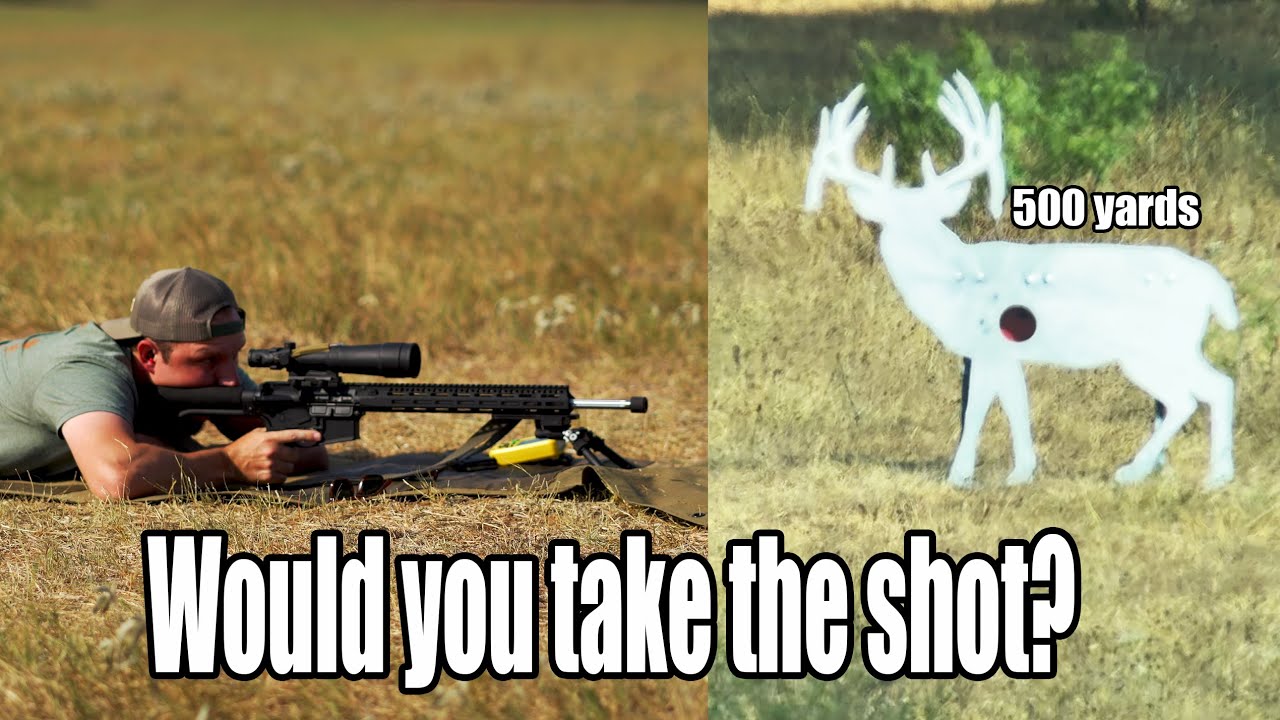
I was thinking about this thread again when Jim’s recent (follow-up) video on shooting a sub-moa group came out. If I know what loads my gun likes, and I shoot those from a well-supported position, sub-moa is usually not an issue. I noticed a lot of those folks did not use rear supports, etc., so I assume it’s just basic stuff that’s being ignored? But anyway, when it comes to this milk jug challenge, I think a pre-requisite would need to be getting that sub-moa repeatability nailed down first. Even then, there is a mathematical problem you would run into.
Let’s say you have a (repeatable) 1 MOA gun from a well-supported position such as bench rest with bags or lead-sled. That means at 600 yards, those same groups may have a diameter as large as 6 inches. But in the field, you likely aren’t going to achieve an ideal supported position every time. Therefore, your groups may realistically be 1.5 or even 2 MOA. Now at 600 yards you’ve grown to 9-12" in diameter. Even at 400 yards we’re talking 6-8" groups at best. Which is going to mean, even without wind or other variables, you are undoubtedly missing some of those shots on milk jugs. A 100% hit rate would be impossible (or extremely improbable anyway).
To me, this back of the napkin math seems to suggest that shots on living animals past 400 yards are extremely risky for most shooters, and I don’t think I could take one in good conscience. I mean the conditions would have to be perfect: repeatable sub-moa, excellent supported field position, etc. Now I live in the midwest of course and we just don’t see opportunities at distances like that, anyway. But even out west, I think I would rather stalk to within maximum point blank range and call it a day, versus trying to push the limits. That appears to be the natural conclusion/lesson based on Jim’s recent videos.
Well, the way the original challenge was set up is the key to the success rate. Unless all that follow use the same rule set; their results are not the same.
Field shooting position
Unknown distances (can use a range finder)
Targets in some cases against a flat plane (ranging becomes very difficult)
Shooting 100 rounds within an MOA is a challenge for any set up or shooter, if done from a field position.
The fact, (at least I have not seen it yet?) that no PRS Professional shooters have taken up the challenge, and posted a video, indicates to me that even they are wary of claiming 100% is possible.
Once you get into cold barrel, wind, unknown distances, difficult shooting positions, etc., things at 500 - 600 become challenging. Watch the 500 yard challenge Eric Cortina is running, even though those targets diminish in size significantly, with a known distance, misses occur on the 4 inch plates.
Really, what the 600 challenge is highlighting, is how little time shooters actually spend on a range, learning the capabilities of the weapon, the round, and the shooters ability to master environmentals to make a cold bore shot.
I just started long range shooting, but I have been working on form and position for years at my 100 yard range (I only just recently found 2 ranges that are 800 or 800+ yard ranges). So, I quickly became proficient at 800 yard or less shooting from a bench rest on a man sized target. So, in these conditions listed I think I would be over 50%, maybe as high as 75%. But the targets are at 100 yard intervals and ranging is not required.
If I were to try to replicate the 100 shot challenge Jim did, I might get 15%-20% under good wind conditions. Milk jugs are significantly smalled and they were often obscured. 7PRC with 3-18x50 Element Titan. I think a 6mm CM or a 22 CM would up my percentage some.
I did see someone try to replicate the challenge, but they were nowhere near 100%.
The Eric Cortina cold shot test is great. Would note that 97% of all shooters in that competition show up with either PRS competition or competition like rifles, and still miss. Wind is the most common thing that defeats their efforts, but quite a few seem to have their elevation off significantly as well, which kind of indicates they did not have a chance to shoot at 500 before they showed up cause they dont have a place to practice, or they don’t know the ballistics of the round, or they don’t shoot enough before they hunt, or all of the above which combines into a big, fat “miss”…but some could still be kill shots.
Yeah, and a lot of those people who Miss say that they would use a different rifle for hunting, one that they even shoot worse than the one that they missed with.
Yep, I think focusing in on one weapon and load for a season is a good way to go, with the exception of hunting inside 250, or point blank settings for the caliber. Shooting one competition and another for hunting…can see some error their in results, but some folks do it. Just got to do the time with the rifle(s) to be on at distance.
Will a deer stand patiently at exactly 600 yards while I change the elevation on my scope, get the bipod out and wait for there to be no breeze? These are fun videos that remind me that buying gear and talking about shooting isn’t the same as being out there shooting at distance day after day.
Was thinking the exact same thing. Around here we hunt typically from either tree stands or box blinds. Dear, especially big bucks do not just sit around and hang out and allow you to spend forever to get set up. You typically have to make a relatively quick shot. Furthermore, you may have a little support from a piece of wood, a branch, or even a metal rest on your tree stand. But there’s no sandbags, bipods, tripods.
But gear is what drives the world! Especially in terms of the internet forums and YouTube. Ever since the internet was created people have been flocking around asking what gear is being used by SEAL Team 6, or the SAS.