I ordered a Brux barrel for 30 caliber what is the best twist rate? Brux offers 1:10 and 1:9. I’ve asked my gun smith and his reply is “it depends”. I’m making a hunting rifle for long range.
I think “it depends” on what weight bullet you are planning to shoot. It is really the bullet length that matters for stabilization, but for a given caliber, if you increase the weight you necessarily make the bullet longer. Also you generally can’t “overstabilize”. Most .308 cal rifles have a 1:10 that is good for the majority of bullets. If you were to shoot really heavy for caliber, I would think 220+, you may want the faster 1:9 barrel.
I live in the Mid-West so mostly deer but the main goal is large game so heavier weight bullets. So isn’t safer to assume the 1:9?
UPR guys are showing a 1:8:5 and they focus on both long range shooting and hunting applications.
If they are at a 1:8:5, which will allow you to use the longest and heaviest bullets, then a 1:9 will most likely do fine.
I don’t think you would be wrong with the 1:9, but I am not sure it is necessarily better. I will say the trend seems to be going with faster twist rates, but most of the loads I see for 300 PRC are in the 180 to 220 grain range which should do find in a 1:10.
There are a few heavy .308 bullets. Hornady has match bullets at 225, 230, and 250 grains, but not sure about those for hunting. Berger has a 245 grain .308 bullet. If you handload the options open even more.
Noting you are interested in long range hunting, have you checked out the Backfire videos on the “milk jug challenge”. Food for thought.
Agree, the 1:10 will work great.
You can use this to calculate the twist rate required to stabilize the bullets you intend to use. Going with the slowest twist rate required for your application is best as it reduces the effect of unbalanced bullets (bullets aren’t perfect). I would suggest that if you plan on running very long match bullets (230/250gr and so on) that 1:10 is definitely suboptimal and even 1:9 is a bit slow.
I have seen the milk jug challenge. I think people like to hype up how good they can actually shoot.
Where I hunt, I have to shoot 125 yards minimum as I hunt over a pond that is 100 yards in diameter. My first deer was at 250 yards. I want to leave the mid-west to get more experience.
Can you elaborate more on this idea for me? I see most rifle mfg’s using 1:10 twist and Proof Research and other barrel mfg’s using 1:9 exclusively. I am trying to understand where the term sub-optimal is being referenced to.
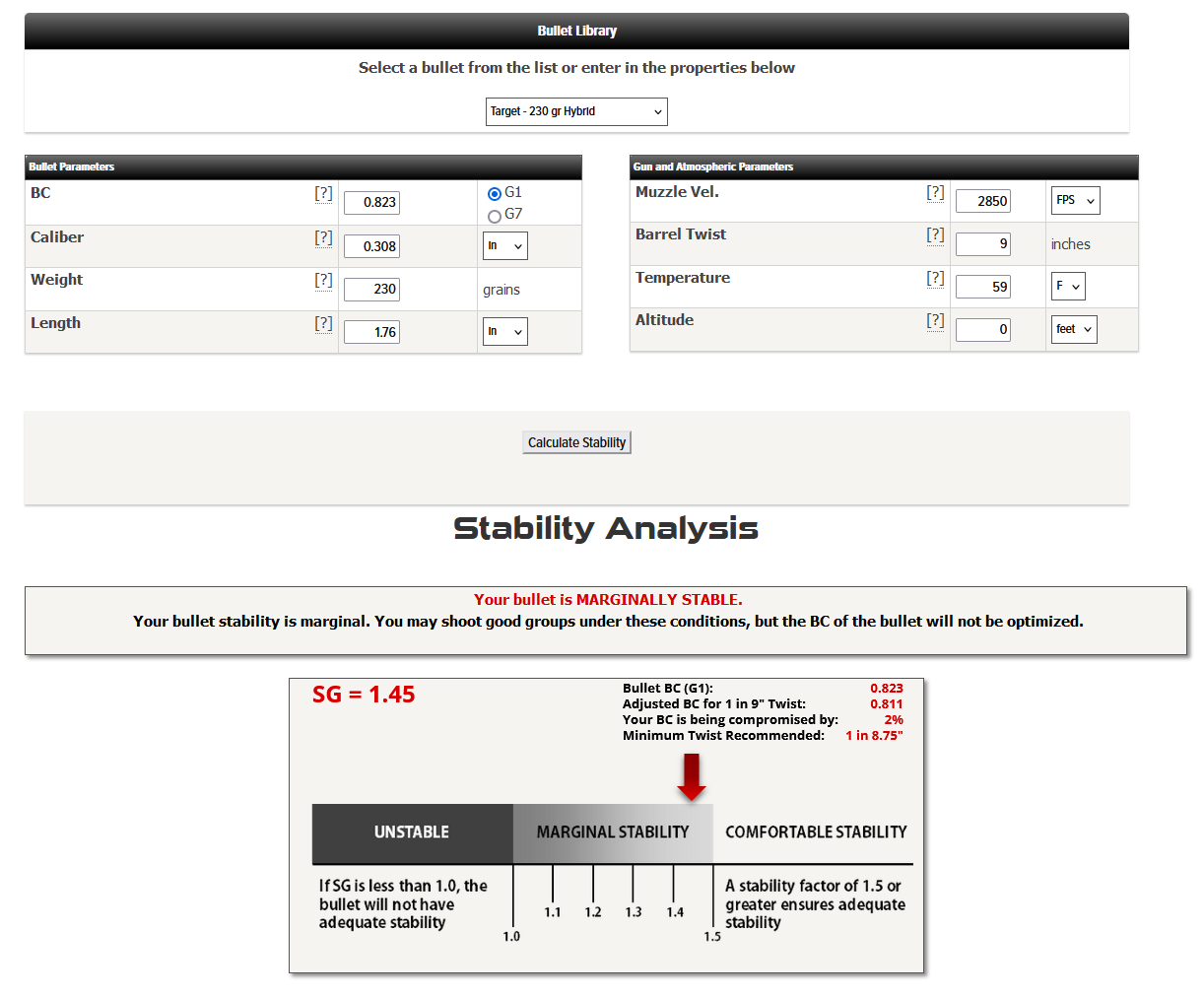
I’m going to agree that 1:9 is going to be ‘good enough’ for the vast majority of people, however if you want to get all the performance out of 230/250 projectiles you’re going to start losing BC. One of the applied ballistics books has a whole chapter on it, but you can use the calculator to get an idea of what works. I’m pretty sure Hornady recommends a 1:8 twist, or at the very least their test barrels are 1:8 for the really heavy rounds.
EDIT: Yeah the effect is really marginal and if you are using it mostly at a few thousand feet of elevation just disregard me and get the 1:9. The point is that you can easily check what twist rate you need for your application and disregard internet wisdom 
The town I hunt in is at 700 feet. I guess I never specified that I plan on going from The 700 feet above sea to 5,500 (Colorado) in elevation. I will play around with the tool some more. I think this is why my gunsmith is saying “it depends”.
Late to the party.
OP: which did you choose and how is it working out?
.
Was looking at different manufacturers twist rates the other day. I noticed that Seekins only does 1:10 for 300PRC, which seems odd as all of their 7 Rem Mags are 1:8.
thinking 1:10 is going to limit usage of long high-BC bullets
I was going to post the exact website page from Berger.
My opinion:
CHOOSE one twist rate, then do some work to figure out what ammo works best for that twist rate and go from there.
You can debate either until the cows come home, but doing a little research and figuring out what ammo (grain weight and OAL) works best for that twist rate will give you a solid performing rifle!
I have done that with every rifle I own, to ensure I have sufficient ammo for each that is a ‘known good’ for that rifle!