So I’ve seen a few threads on here regarding 7PRC and pressure but wanted to get y’all’s take on how to approach a few things regarding newly loaded brass.
Here’s the setup:
Rifle: Brand New Weatherby 307 Alpine CT (22” barrel) - this was the first 20 shots fired through the rifle
Brass: New Hornady 7PRC Brass
Powder: H1000 (66.1 gr based on 67.1 being the max shown in Hornady manual)
Bullet: 175 ELDX
Primer: Remington 9 1/2 Magnum Rifle Primer
I loaded 20 rounds without sizing the brass but did run it through a Forster benchrest sizing die with an expander ball (made sure not to push back the shoulder). I also chamfered the case rims as well after running the expander ball through. When I went to the range to zero/break-in, I had one shot that i didn’t fire as I got decent resistance chambering (wondering if maybe i didn’t seat the primer all the way?). The rest chambered fine but i did have one round have a definite heavy bolt lift after the shot. I shot strings of 3 with about 3-5 minutes between strings for quick cleaning. Looking on about the last 10 rounds, there is a slight extractor mark on the bottom of the brass. Outside of one round, the load data was what I’d call ok (for 18 shots: AVG - 2787, ES - 57, STD - 17.3). But there was one round that was a full 300 fps faster than the rest (heavy bolt lift).
Definitely going to back off powder charge a bit but here’s my questions:
Is there something inherent with the PRC cartridges that they are seeing pressure signs below published max’s? I know there are other factors beyond powder charge but it does seem like there’s a lot of posts of 7PRC in particular showing pressure signs consistently
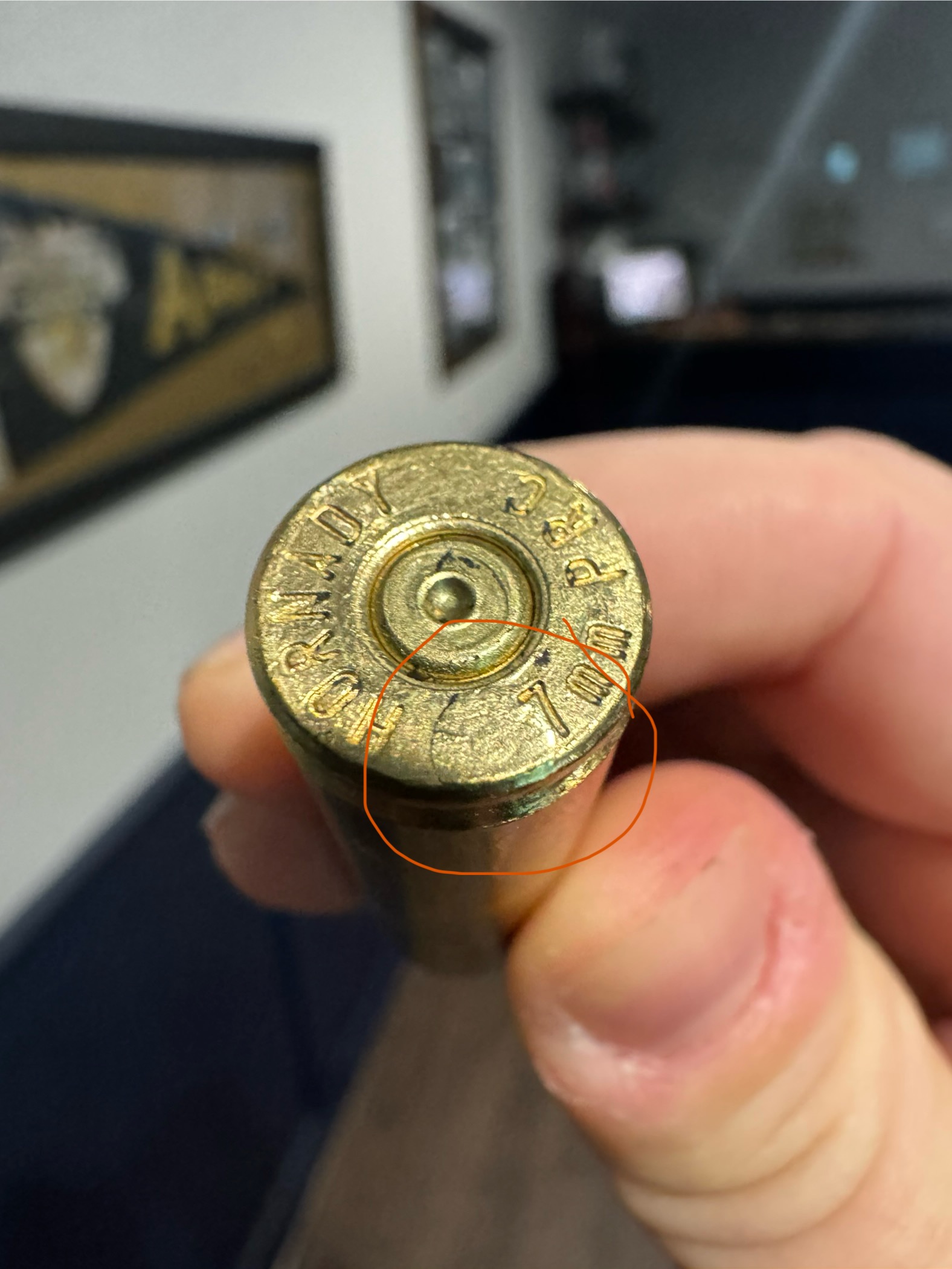
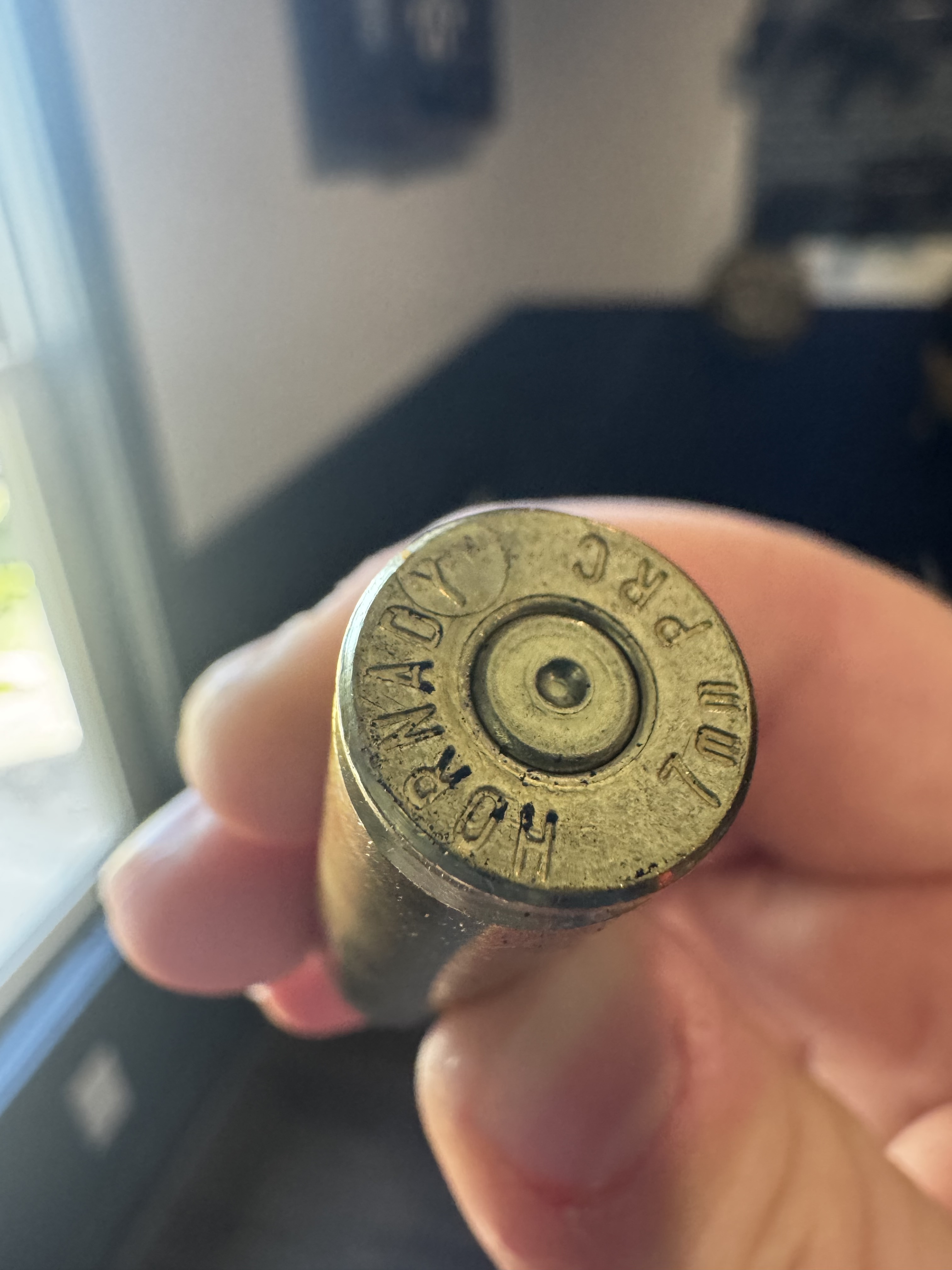
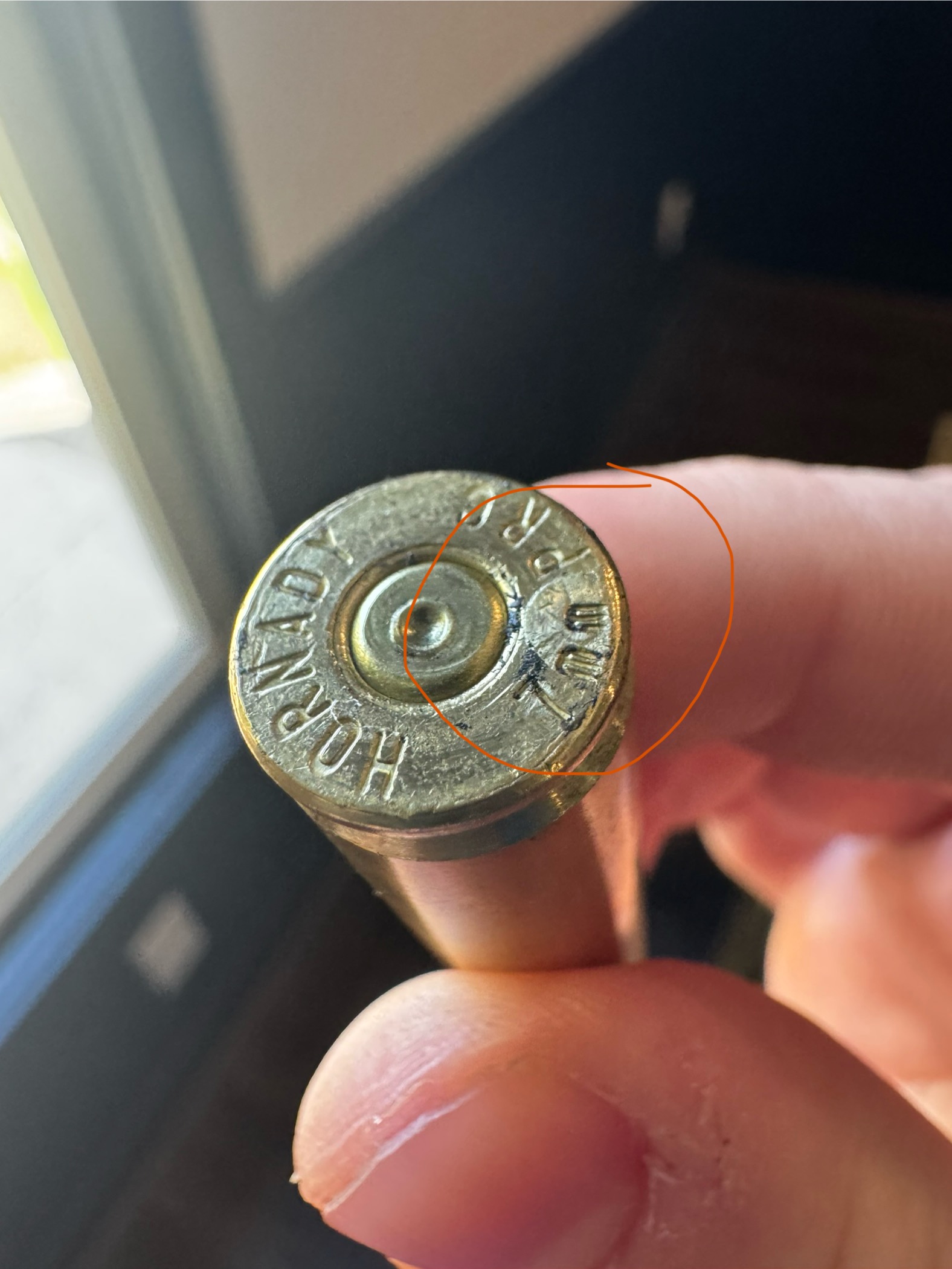
What should i do with the cases with extractor marks on them? Is there a line where they are still usable or should i generally toss them to be safe?
What’s the most likely culprit for the one round with heavy lift and 300fps increase in speed? My gut was that somehow the bullet go crimped or I added extra powder but I also feel like i was pretty careful not to do either.
For the cases that I do reuse, should I hold off bumping back shoulders (I’ve never reloaded new cases before)? If so, should I just wait until the spent case doesn’t chamber well to bump it back?
Here’s a sample of some of the extractor marks. Ranges from obvious to hard to tell. Given it’s Hornady brass I’m guessing some of these might have happened either way but some appear to be directly linked to pressure. There were about half without any marks.
I don’t know but i get similar issues with my 6.5 prc.
I read that carbon rings can build up fast and cause issues due to the chamber specs being so tight?
Interesting.
I wouldn’t necessarily worry about an ejector mark if that’s all you see. Some bolts show ejector marks no matter what.
The load that was 300fps over the rest is EXTREMELY dangerous—to the point that I’d stop shooting immediately and pull the rest of the bullets to see what’s wrong with the ammo.
As for the culprit, that’s a tough one. My first thought is probably just too much powder but 7 prc really shouldn’t even have enough excess powder capacity to put in that much extra h1000 to get to 300fps over. It’d have to be an insanely compressed load which I think you’d notice.
So I’m scratching my head. Not sure what would have caused that.
Wondering if bullet seating got hosed up somehow. As a result, chambering the round actually touching the lands, causing the pressure build up and increased FPS?
I know in the past you said that almost all of the overpressure problems were happening only in higher end firearms. The cheap rugers, Etc were doing fine.
check your scales: if digital re zero and check the batteries, if mechanical re zero and make sure the weight markers are actually in the correct spot as you load. If you bump the bar while handling the powder pan it can cause things to be off.
check your seating depth - if you are running into the lands it can cause pressure spikes
when you load your primers, take a look at the seat and run your finger over them, it is pretty easy to feel if a primer is extended out farther than it should be from the primer hole.
set up your dies to resize the case exactly the way the die maker instructions dictate; once you are resizing fully, and things are working smoothly, then you can start working towards minimizing shoulder bump, etc.
new brass, other than sizing to ensure the case mouths are uniform, should not give you any issues. Resize the once fired brass fully also.
Since you are new to the reloading process, the more you can go back to a standard set up baseline the easier it will be to figure out which way to go; sounds to me like you may have “too many things going on” at one time: seating depth, if you have a factory 7 PRC loaded round, I would just match your reloaded rounds to that length to establish a seating depth baseline.
Be patient, loading centerfire rounds is not hard once you get the hang of it, but it is fairly simple to create a bad situation by having a little too much powder, a bullet seated into the lands, a primer not seated correctly, etc. and when all those things come together in a round, you can get an accident.
CChilds, interesting comment. I once shot in a competition with a bunch of law enforcement people. One of the teams had brought two custom made rifles, and the weapons shot quite well. The guys explained that the tolerances were super tight and that was what made the accuracy great. Day 2 of the competion, it rained pretty hard on us while we were on the firing line; the guys with the super tight tolerance weapons…well the bolts would not close when rain water got into the chambers as there was not place for it to go. Not suggesting this is the problem with the 7 PRC line up, but things can be too tight from a machining standpoint when it comes to metal parts.
JV
I’ll definitely be keeping an eye on the garmin during the shooting strings (rather than after them) in the future so i have another data point on when to stop shooting from a safety standpoint.
As far as seating depth, I was seating about 75 thou off the lands so wouldn’t think that would cause an issue. I also made sure to measure CBTO for each of the 20 rounds and all were within 1-2 thousandths of each other (using forstner micrometer seating die.
In general, my takeaway is that I should probably hold at least a few variables constant rather than combining a new rifle, new cartridge, new brass, etc. Probably will send a box of factory ammo through first in the future just to get a baseline.
And for the round that wouldn’t chamber, I validated that the CBTO and shoulder measurements were good as well but the primer was not seated sufficiently and was sitting out by about .004” rather than recessed by 1-2 thou.
I’m wondering if the same happened to that round with excessive speed but maybe wasn’t seated quite as far out. Might not have felt hard to load but put enough pressure forward on the shoulder to pinch something?