When you did your research regarding rifle companies and their definition of what passes, and doesn’t pass their accuracy guarantee; did any of the companies disclose their testing protocol? Specifically, how a group was actually shot?
I bring this up because of two recent things.
I found a thread on another Forum within the past year. I cannot verify how authentic it is, I don’t know the person posting, etc. I hate to spread internet rumors. However, it dealt with a man who purchased a Weatherby rifle and was unhappy with its accuracy. He shipped it back to Weatherby for testing. According to him they examined the gun, found it to be somewhat dirty, cleaned it, then shot two subsequent three shot groups Each of which beat the accuracy guarantee of one MOA that they promised. Apparently if that’s the case Weatherby charges you $200.
The more interesting thing to me however was that they discussed their testing protocol to the man in their report. They stated that they waited between 3 to 5 minutes between each subsequent shot. Not between the groups but each individual shot.
That’s not how most hunters would do a three shot group at all. It really doesn’t apply to any particular type of hunting situation. But it does make me wonder comparing what a consumer, hunter tests in the field versus what the rifle company is doing in the lab.
On your recent podcast about barrels, you mentioned that for your really lightweight gun like the Kimber you typically don’t shoot more than twice before letting it cool down because of the thin barrel.
Just curious because if we as a community are trying to compare gun number one versus gun number two in terms of MOA values, but we are using completely different testing techniques, they aren’t really valid comparisons.
Heck, there’s one guy on youtube, I can’t remember his name for the life of me, who states that for sighting in his hunting rifle and determining group size he leaves his gun and ammo exposed to the outside temperature overnight, gets up first thing in the morning and puts up a Target and shoots one shot at it, packs everything up and takes it back home, then repeats a Cold Shot for 3 to 5 days in a row to get a group, uses the same Target for each shot.
You’re exactly right to be thinking about this. Personally, I think the accuracy guarantees from companies are worth precisely NOTHING. Zero. Nada. Zilch.
Almost all of them just say that they have to produce a 3-shot 1-moa group. No mention at all of how many groups they can attempt before they get one. It’s complete trash.
Bergara and Gunwerks have the only HALF-decent guarantees and I still have issues with how they do it.
I think this goes a little bit bigger than that however.
If I report a group size for a three shot group shooting 5 minutes between each of the three shots, someone else with the same gun and ammo reports their 3 shot group but there’s 24 hours between each shot, and another person reports with the same gun and ammo but he’s shooting as fast as possible; those really aren’t comparing apples and apples.
Group size guarantees are extremely difficult to match on hunting rifles; while I feel that modern barrels are precise enough to get sub-moa consistently with proper ammo if you strap it into a rail gun, lightweight hunting rifles are incredibly dependent on the shooter and cartridge because of muzzle shift before the bullet exits the bore. Note that suppressors and muzzle brakes don’t help as the shift occurs before the gas is redirected.
This makes sub-moa guarantees extremely problematic, though as I mentioned before I actually do believe that the barrels and actions are fully capable of sub-moa performance for the vast majority of newly produced rifles.
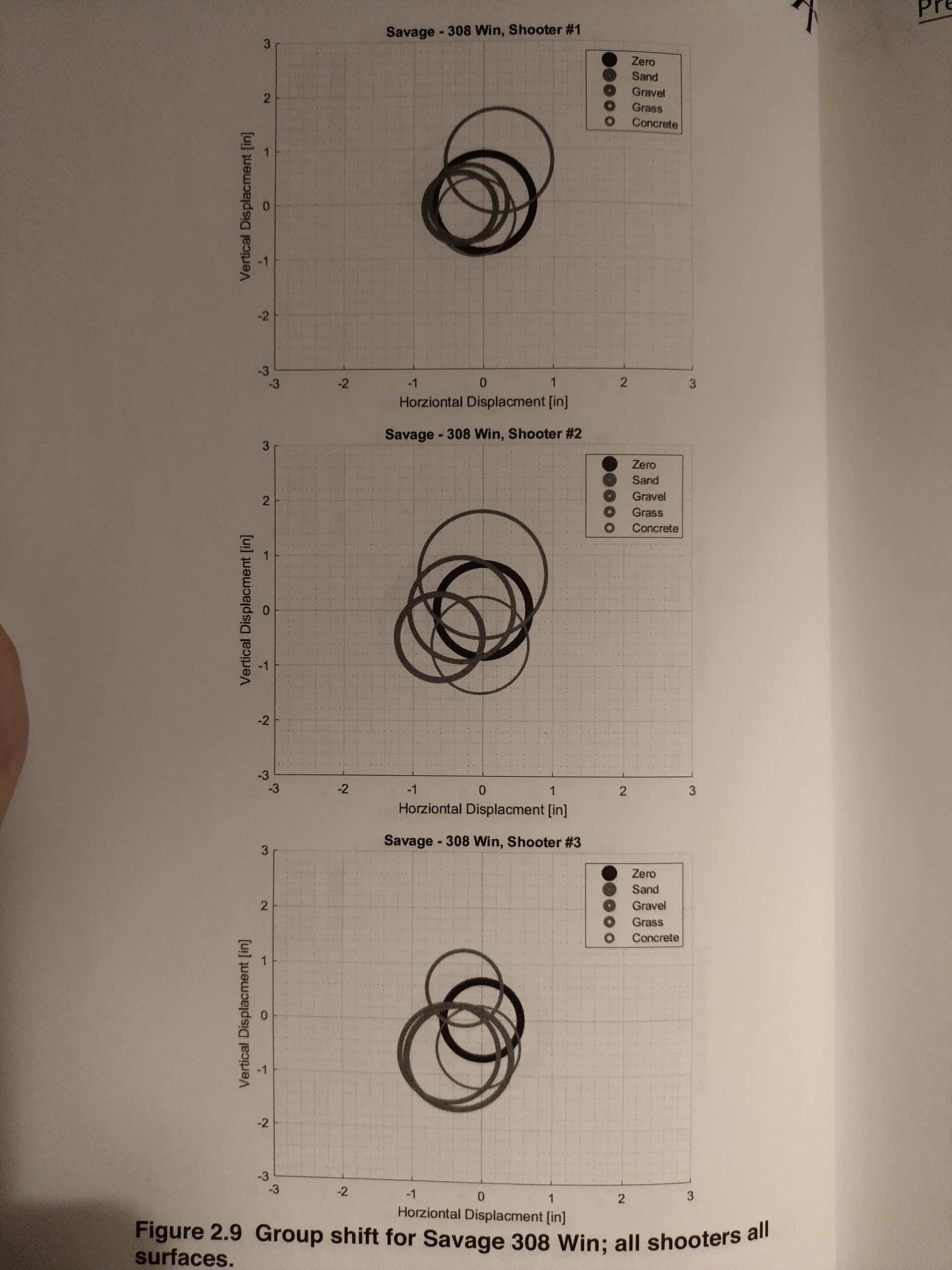
I was just reminded of a test Applied Ballistics did trying to figure out an answer to this very question, they had 3 different shooters shoot multiple groups out of the same rifle on different surfaces (prone, supported) -
If just the surface one shoots from, and shooter to shooter variability results in differences in group size this large, I wouldn’t be so hasty in dismissing manufacturer tests assuming that they use a standardized test rig.
The issue is that their tests aren’t statistically valid though. If all they have to do is produce a 1 moa group of three shots but they don’t specify how many tries at that grouping they get, literally EVERY gun passes that test because eventually three will land next to each other.
Yep, this absolutely is an issue. Accuracy standards for military gear use upwards of 20-30 rounds to establish a baseline (with a price premium to match).
Setting that aside I do have a fun video idea, take a 300 prc or win mag hunting rifle that does 1.5-2 moa and strap it into a 15-20 pound PRS or benchrest stock and see what happens.