Found my Node, now what?

Here are the specs of my load development, I figured I better answer this as this might be the first question back to me:

CBTO = 2.6710
Seating Depth = 2.6510
COAL = 3.3670

My chamber to LANs is way over SAAMI spec. So I used GRT to help me find what my max pressure would be when I sat the bullet out to where my rifle allows. All the following are under max pressure and I had no trouble loading, no pressure signs.

Using H1000, I started my last load development at 65.0 grains and went to 66.0. Since I was over the Hornady Max of 64.3 , I did 1 grain increments.

The Node started at 65.4 and went to 66.0. At 65 to 65.3, the results were unspectacular. Starting at 65.4 this is what I got:

3 shot groups

Grains / Ave Velo // SD / ES / Spread
65.4: 2870; 3.0; 6.9; .20
65.5: 2867.2; 24; 54.5; .93 (this was the outlier)
65.6: 2861.9; 6.2; 15.1; .53
65.7: 2892.5; 8.0; 19.4; .80
65.8: 2896.0; 9.0; 22.0; 1.46*
65.9: 2911.3; 2.6; 6.2; .99
66.0: 2919.9; 5.9; 13.8; .30

On the 65.8 and 65.9 I had a gas gun next to me with a loud break and on the first shot on each of those, he pulled his trigger a micro second before I did and I flinched each time. Hence the larger spread. Otherwise the other shots were same hole like 66.0.

So my question is which of these is going to be my best load? 65.4 and 65.9 gave me the best overall numbers (minus the one shot on 65.9), but I still got good results at 66? Which of these is likely to give me the best, most consistent results over various temperatures and distances shot?

Thanks in advance.

I bet if you did that same test 5 it would end up different each time . Chasing nodes like that takes a lot of data to get an accurate answer to what your trying to find. And the 3 shop groups size is too small to get measure and repeat. Just my thoughts.

Cool to see the test data.

I do agree with Walter on this. If you look in the reloading course on Backfire Plus, you’ll see where we ran this test, and then ran the same test 5 times. The nodes were different each time. If the test were valid, we would have gotten the same or similar result when we ran it each time.

Basically, there is no such thing as a speed node.

I’d shoot where you’re comfortable with speed and pressure. Accuracy would probably take at least 20 shots to be able to tell the difference in big changes in powder charges (way more than just a half grain).

Based on this info, I’d come down at least half a grain from the listed max load if it’s safe, and call it a day.

It’s fun learning all this relaoding stuff. Lots of different opinions, so take it all with a GRAIN of salt (see what I did there?

Took your advise and watched your tutorial. So, I think we are working with different definitions and that is my fault as I am really new to this all. In my defense, I will say that I have thrown myself into learning as much as I can over these last 2.5 months. Professionally, learning is my business and it is something I truly understand, so my learning curve is pretty steep. None-the-less, I should have been more clear on what I meant and what my goals in my testing were.

When I wrote “Node”, you read velocity. But, what I meant was consistency in all measurables - which is what I learned in another course I took. I was working with the assumption (if it is even an assumption as opposed to fact) that increased powder generates increased velocity. My only goal with Velo was to be consistently at or above 2850 ft/sec. What I wanted to see in my Node was a range where I was getting good to great SD and ES and sub MOA accuracy.

To make sure we are still on the same page, this is what we do with factory loads, right. We are looking for ammo that our rifle shoots accurately and consistently. This data matters. Each manufacturer is slightly different, which is why my 7PRC loves the Federal Premium ELDx 175 but hates the Hornady Precision Hunter with the same bullet.

So my goal was to find that in my hand loads (again its SD, ES and Accuracy). Prior to my last results, I tried 20 different grain weight and 2 different powders, all shooting 3 shots. Never in those 3 shots groupings did I get sub 10 SD and Sub 20 ES, with some shooting at MOA or better. Before you come at me with 3 vs 5, if it doesn’t do it at 3, its impossible to get at 5. That’s just logic.

The max pressure I have in these load is 46657 according to GRT, which is way under the max 65K. This is extremely curious to me since I am getting the velo I am getting. Which is why I had increments of 1 grain instead of the more common 3 grain jump. I was too nervous to go that route being that I am still learning about all this. I checked for pressure signs after every single shot. This was NOT about chasing velocity, but was for my own sanity and safety.

I am also confused by your comment, “Based on this info, I’d come down at least half a grain from the listed max load if it’s safe, and call it a day.” Do you mean my data or are you referring to Hornady’s data? If you mean my data, my question below is answered, if otherwise…

So, back to my original question. Considering the concept that accuracy is atmospherically dependent and, as some suggest, its better to be in the upper range of a “Node” (not velocity Node, but consistency Node), is it better for me to find the best of the consistent loads in the upper range or the best overall (which was the lowest)?

The XXL website, just explained this. H1000 doesn’t go to Max PSI for cartridge, but to around 50K. So my 46600 isn’t so far off what “max” is.

One of the joys of reloading is you can take it as detailed as you want, or as simple as you want. I’ve seen people online Chase seating depth changes that are smaller than what the actual calipers can measure. Same for powder charge, Etc

I’ve lost track of time but I’ve been doing this for at least three if not 4 years now. I have definitely over this time frame gone from being more detailed and persnickety to the more Global approach that Jim recommends as well as what Hornady and form from Rockside preach. They’re slightly different but same general principle, load up something see if it works and if it does go for it and if it doesn’t abandon that and go for a major change. I’ve also seen so many posts or YouTube videos where someone who used to be the most meticulous reloader in the world has definitely switched to the more simple path recently. Do the best that I can recall I’ve never seen someone post a post or a video where they went the reverse direction.

I don’t hate sitting at the reloading bench, but I’ve gotten to the point where I’d rather get something done more quickly. Some months I might only be able to make it to the range once or twice to test. If it’s going to take me 20 range sessions to come up with a load then I’m going to go all the way through hunting season and then some.

You are correct, es is not going to improve with more shooting. So whatever your three shot ES can only get worse. However, SD which is a much better predictor of what your round will do, definitely improves with further shooting. An SD based upon three or five shots is basically completely useless. I believe it takes 10, 15 or even 20 shots to get a meaningful value.

But, if tinkering around is what you like to do then by all means go for it and enjoy!

It’s just that simple statistic says that in order to really tell the difference between two different groups, load recipes, you’re going to need to shoot 15, 20, 30 shots with both of them to see if there is a meaningful difference between them and that’s going to burn up a lot of components.

So, without trying to brown nose, I’m going to go with Jim on this and just pick whichever one gives you the velocity you want, need for your particular hunting situation and test it and see how it does with a larger group size

OK - I went through the Hornady Podcast. I had Gemini break it down step by step so I didn’t miss anything. Here is the thing I still don’t understand, so if anyone can help me I would appreciate it.

Here is Gemini’s explanation of the Hornady Method in terms of finding the “flat spot”:

" * The Goal is a “Flat Spot”: You want to identify a specific charge weight where small variations in powder weight do not result in large swings in accuracy or velocity (59:20).

  • Test Up and Down: Once you find a charge weight that shoots an exceptionally tight group, keep your bullet seating depth completely locked in place (58:48). Then, deliberately load test strings slightly above and slightly below that charge weight (e.g., testing variations like 43.2, 43.5, and 43.7 grains) while monitoring the dispersion pattern (58:56).
  • Replicate Extreme Weather: In laboratory testing, artificially increasing a powder charge tightly mimics the exact pressure curves and dispersion behaviors that occur naturally when shooting out in extreme environmental heat (1:00:03). Finding a charge window that performs well across these simulated pressure changes ensures your standard deviation survives cold mornings and blistering afternoons alike (59:44)."

Bullet 2 sure looks like a ladder test.

What am I missing?

Did I miss something here? What caliber are you loading?

Please don’t read this message is rude because I want to be direct about my thoughts here but I’m also very passionate about this topic so I may come off strong :grin:

“Flat spot” where small variations in powder weight do not cause large swings in velocity? Does not exist.

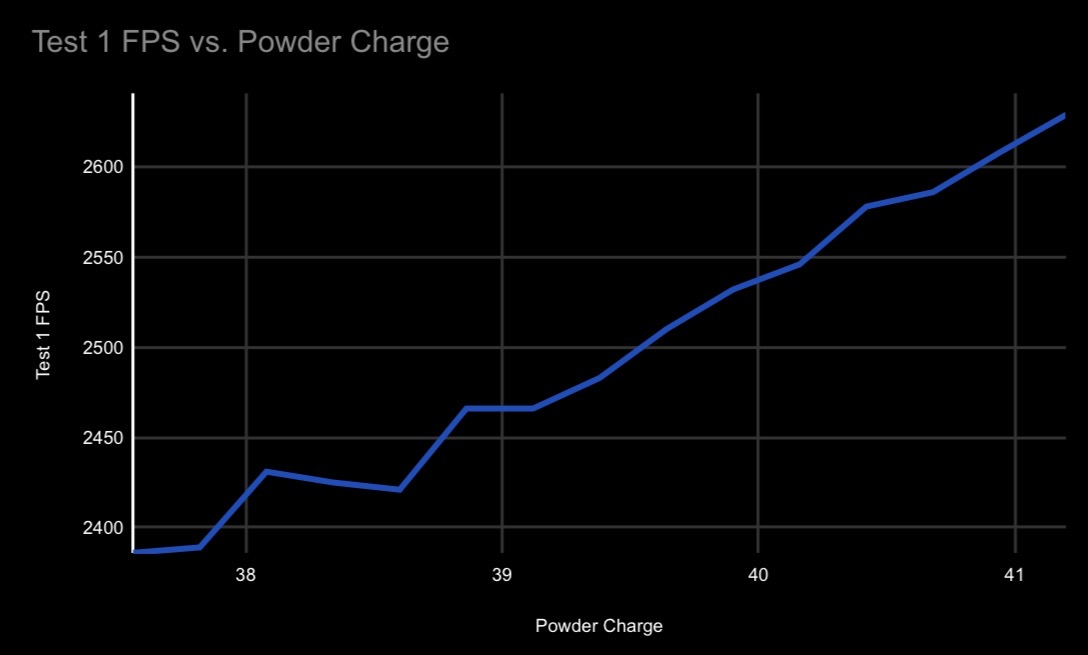
For example, here’s a powder charge ladder test I did.

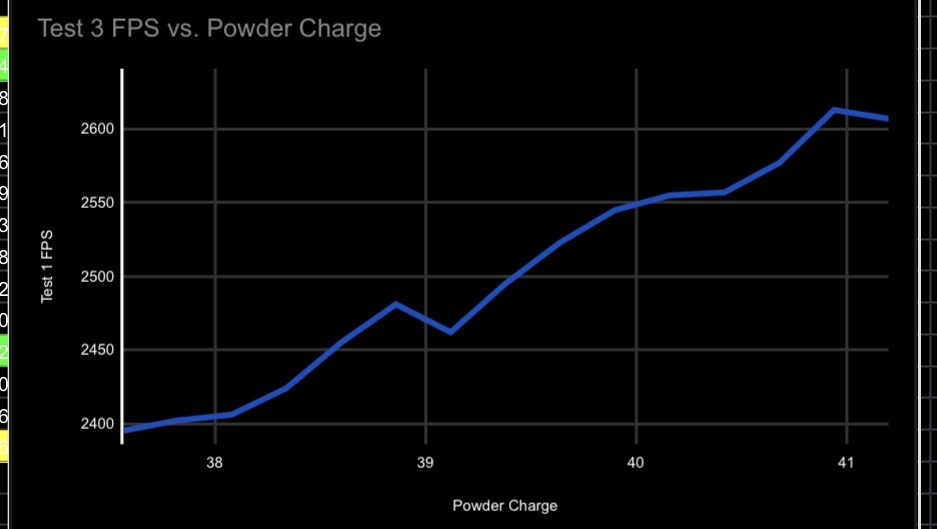
Looks like a flat spot at 38 to 38.5, and another at 39 to 39.3. If the test is valid, if I go through all the work of running it again, I’d get the same result, right? Here’s what happened.

Completely different result. The test is simply invalid because too few shots are being taken at each setting to be statistically significant.

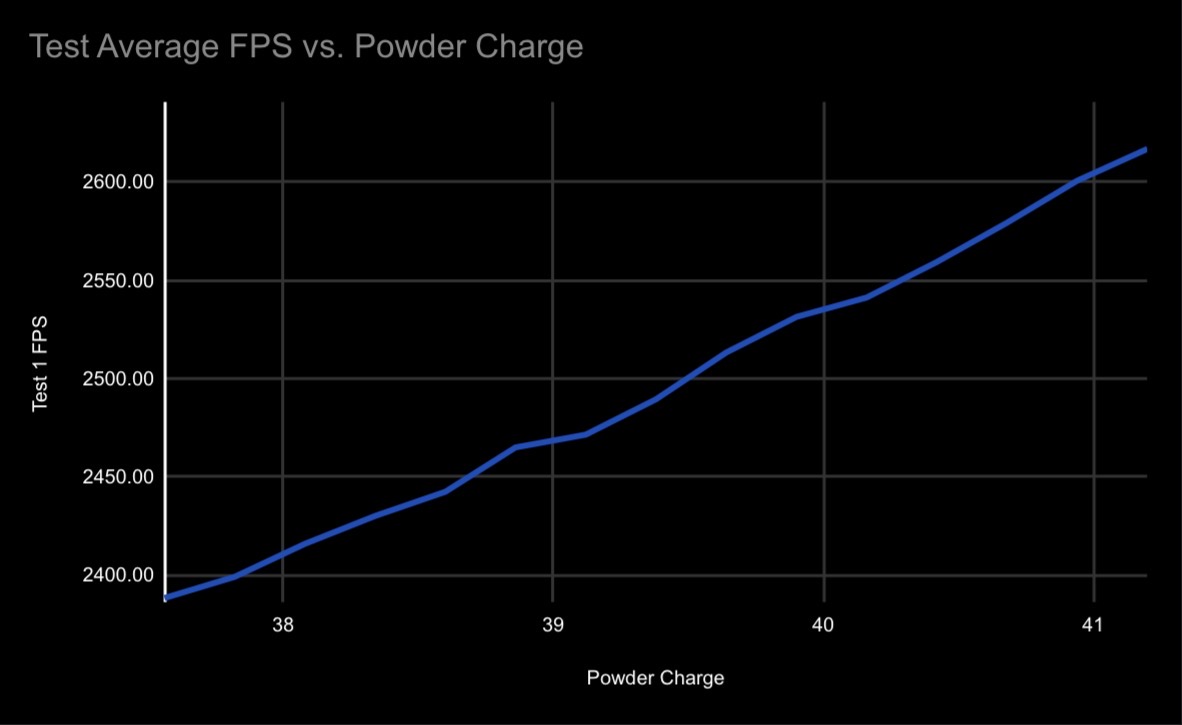
So what happens if you do the entire test NINE TIMES? I did exactly that. Here is averaging all of the shots at each setting.

The result? An almost perfect straight line. Each time I add more tests, the line gets straighter. There’s almost not even a wiggle in that line.

I believe this testing proves my hypothesis. There is no such thing as a “flat spot.”

That frustrates reloaders. Frankly, this method is how 99% of guys have done reloading for decades.

Now, you mentioned the “Hornady method.” I’d definitely take issue with the AI summary, because that actually the opposite of their approach. I load the same way they do, and it’s following statistics :grin:

The goal is not to find a nonexistent “flat spot” where velocity, es and sd, vary less. There is no point that somehow magically becomes flat despite having more powder at that setting.

What DOES make a difference is tuning the load to jump the right amount, and have the right pressure signature for the bullet you are loading. But to know which is the best setting, you’ll need to make BIG changes and shoot LOTS of shots in order to have a statistically significant test.

Suppose I’m testing a 6.5 creed handload. First, I’m gonna just pick a known-reliable powder for accuracy in that cartridge. If you can’t get a good result with h4350, something is wrong. So that’s what I’m using. I won’t even try other powders unless I really get desperate.

Next, the powder charge. Depending on my velocity goals, I’m usually a half or full grain down from the listed max. Usually works.

The big one is the bullet. I usually try two or three. To get a valid result, it’ll probably take 20 shots PER BULLET. I wouldn’t be mad though if you just shot a ten shot group with each as long as we acknowledge we are just cutting out any obvious failure in bullet choice but recognizing we won’t have enough info to choose between the mean radius of .32 and .35” or other small differences in bullet accuracy.

Usually, that’s the full process. But it’s maddening, right?! How do you know if 41.y is more accurate, or 41.5?!? You simply can’t. It may take 100 shots to know how that small of a change will impact accuracy because they’ll be so close.

Even if you did shoot 100 shots accuracy testing those settings, the barrel literally wears out slightly in 200 shots so you wouldn’t know if it was the bullet or the barrel condition.

Then there’s bullet jump. It can definitely impact things. I like to test at least 10 and probably 20 shots at each setting, and I’ll test BIG jumps to see if it improves accuracy. often test 30, 60, and 90 though off the lands.

But that’s all we can really do. It just takes too many shots to test fine differences. For the best results, test the BIG levers that impact the load accuracy the most—which bullet, and jump. For powder charge, just pick one that will hit your velocity and will not go over pressure.

There are so many variables that most reloaders create invalid tests that make them feel better, but simply don’t pass scrutiny.
That was a very thorough explanation and it helped tremendously. Thank you.

The funny thing is, prior to reading this, what y’all wrote sounded like throwing spaghetti at the wall and not using data at all and that was what frustrated me. I definitely have a better handle on it now.

But, I feel like I can still use the small sample of data I have. I know that 55.4 grains and up give my velocities I like. I already know that my gun like ELDx, and H1000 is a good powder for 7PRC. So I just need to play with the jump.

Prior to this, my plan was to take what I had and load 20 shots to confirm the small sample. Basically, that stays the same. If my results are good then perfect. If they’re inconsistent, I need to fiddle with the jump.

Oh man! It’s definitely data driven. In fact I would say that’s one of the core principles.

I would say that ( let’s call it) the modern load development technique is based upon;

  1. Use good data. That means larger sample size. Not just using a single three or even five shot group to make a decision
  2. Don’t expect some minor, minuscule. adjustment to make some major change in your outcome. Even if that did happen, it would take so much testing to prove it that you would burn up way too much money and time to find out. If something isn’t working then pull a big lever like different bullet, different powder.
  3. Set a goal and stop when you hit it.. A specific muzzle velocity, a specific accuracy range. Don’t spend your time chasing smaller, smaller, smaller groups or trying to get the absolute maximum velocity without blowing up.

Keep in mind that most of this has been tested with modern cartridges, Creedmoor and newer, and newer bullets. If you’re going to use an old 30-06 and a 1950s designed Spire point, things may be different.

In terms of seating depth, keep in mind some bullets are more sensitive than others. The eldx is actually one of the least sensitive ones out there which is a design goal of theirs. Some of the newer Berger bullets are similar. Older designs like the ttsx are definitely more sensitive and require more testing. As Jim mentioned if you’re going to make a seating depth change make it a big one and not go chase some number that you can hardly even tell apart on your calipers.

Perfect! I think that’s an excellent plan. You already have a few of the big pieces in place for figuring out your load.

Jim’s explaination is spot on. He has a great 6.5cm load. I took his load data, loaded rounds, shot the out of a Sig Cross like he uses, Used a Garmin Chronograph, with the same results, and had a SD of 5.

I have given my load data to several people for a 6.5prc, and the got the same results I did, with a SD of around 5 also, and 1/2 MOA.

What would you consider a big swing in powder charge? What about seating depth?

For seating depths, at least 25 thou (0.025), I’ve seen some preach up to 40.

Powder typically represented by a percentage. But in simple terms For something small like an ARC, 0.5-1.0 gn. For a magnum then 1.5-2 gn

Who-tee-who posted a video with a -.025, .000, +.025 seating depth either yesterday or today. Haven’t gotten into the good part of it yet.

One more question…

So I loaded up 20 at 66 grains and another at 67.5 grains. 67.9 grains would be at the Hodgens Max pressure for H1000 for 7PRC, which is well below the 65K from SAAMI. So, I should be good pressure wise.

I watched the Hornady Podcast on this topic and they were convincing on why 20 shots is the min and since this rifle is a hunting rifle, I know I will doing what Jim did shooting 4 five shot groups.

My question is, do I shoot 4 five shot groups at a single target or do I do 4 different targets?

If 4 different targets, is their a measurement recommendation for how to process that data? I haven’t seen anyone cover that part.

I swear there’s a thread on here somewhere about how to do this but I can’t seem to find it right now to save my life

There’s the old fashioned, manual way. When you hang your four targets be absolutely certain they are perfectly leveled. Shoot your groups at the different targets. Have a fifth blank target. When you’re done you will lay one of the group Targets on top of the blank one and Center it up perfectly , and make sure they are leveled , and then use a pin to Mark the shot holes onto the blank. Then repeat with Target two, three, and four. Then have a composite group and you can take measurements with any of the ballistics apps

There is an Apple app named shot Fusion which is supposed to do this for you. I have not had a chance to use it yet as most of the stuff I have is not Apple

There’s always electronic targets like what Cortina uses. I’ve never investigated how much cost they are, or how difficult they are to set up and use

In this case, I think you’ll get more out of it by shooting separate 5-shot groups at four different targets. The reason is it’ll encourage you to break and let the gun cool between groups, and you won’t cover up the aim point with bullet holes.

But the big reason to shoot them as separate groups is you’ll be able to see if there is point of impact shift between groups because of differences in how you address the rifle.

That was a super good explanation Jim! It made it easy to see and understand. Idk how YouTube is with this kind of stuff but it would be cool to see a video talking about this topic. I spent way too much time and money when I started reloading chasing these “ flat spots” I wish someone would have told me I was wasting my time way sooner. In fact nobody ever told me I finally had to figure it out on my own.