I just finished the scope mounting course and I wondered how everyone else levels their scopes? I agree with Jim’s plumb bob method other than I think you must level the gun as well.
I personally own 4 different methods/devices to level. My favorite is the scope jack by Fix it Sticks. If you have a picatinny rail under your scope, it works great! It pushes up on the flat bottom of the scope. My second choice is a set of scope wedges. I use these when I don’t have enough clearance for the scope jack. They do the same as the scope jack by using the bottom of the scope. My third route is the Mount it Right kit from Real Avid. This shines a light through the scope and projects your reticle on a gridded sheet of paper which is also leveled. This is probably the most accurate and best way, but it just takes a lot of setup. I use this if when there isn’t a flat spot on my rifle under my scope. This method also trues the reticle to both true vertical and straight in line to the barrel. My last option and least favorite is the three level system. Level the gun, then clamp a level on the barrel, then level the scope. I only do this as a last ditch effort.
Actually you don’t have to level the gun, but you can if you want. I do sometimes but other times I don’t. The reason is that some of my rifles just fit into my shoulder best at a slight cant. Since the barrel is radially symmetrical it doesn’t matter what you define as up. I define up on some as as few degrees rotated clockwise. As long as your optic recital is aligned with gravity you are good to go.
As for the process i hang a horseshoes at the end of a string on the barn, sit off a ways and alighn the verical retical with the string.
I wonder why the scopes don’t have a vertical line on them on the outside bell ring and the rifles with a center line on the barrel and just line them up? Why would that not work? You could use a straight edge from the barrel to the scope line.
I think the machining tollerancrs would have to be very very precise for both the rifle maker and the scope maker. My guess is it would be very hard to have good accuracy and it wouls cost a lot.
I think that those would be much better than a bubble level from a tolerance pov that many people use and certainly better than us looking though a scope and guessing.
I agree. But i dont use a bubble level at all for leveling. Just the reticle and a string with a weight on it. The bubble level just tells me ive got the gun to my shoulder correctly. I suppose other people do it different.
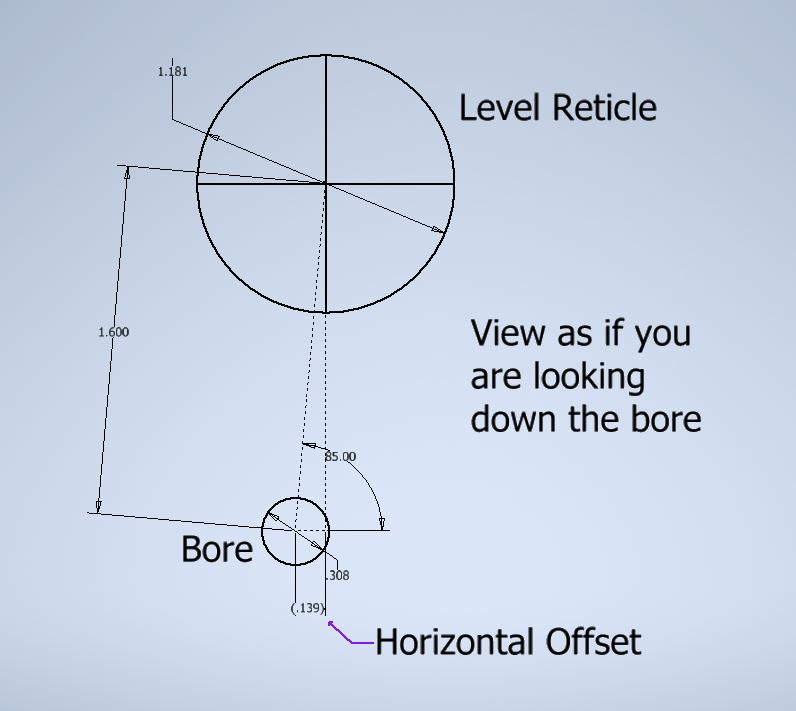
Okay, I did a little math. If the scope is mounted 5 degrees off, with a scope height of 1.6" (measured on my Tikka with a VX-5) that puts the scope at 0.140" (about 9/64") off the bore. If you zero at 100 yards then that means at 1,000 yards you will be off by 1.260". 500 yards is only 0.560".
That just completely changed my way of thinking while leveling a scope! I spend WAY too much time leveling the scope to the gun.
I have the Real Avid kit you mentioned and I like the way it works. I also have the flat spacer tool you mentioned that I’ve used with picatinny and a scope with a flat spot but I don’t feel that it’s accurate enough for my perfectionist tendencies.
Real world…maybe eyeball is good enough, but you generally only set up a scope once so might as well take a little time and get it on as good as possible if you can IMO.
Using one of the more popular mathematic models on rifle can’t trajectory, if you’re shooting a 308 win at 1,000 yards, a 1 degree can’t would put you off by 8.75”.
@backfire So then why don’t you make sure the gun is perfectly level as well as the scope in your scope mounting course? In the video you just eyeball that the gun is level in your vise, then level your scope to your laser-level.
I watched video you linked and I see what you are saying. I think the discrepancy between my numbers and yours is that I am assuming the gun is canted, but the scope is perfectly level. Not that both the gun and scope are canted.
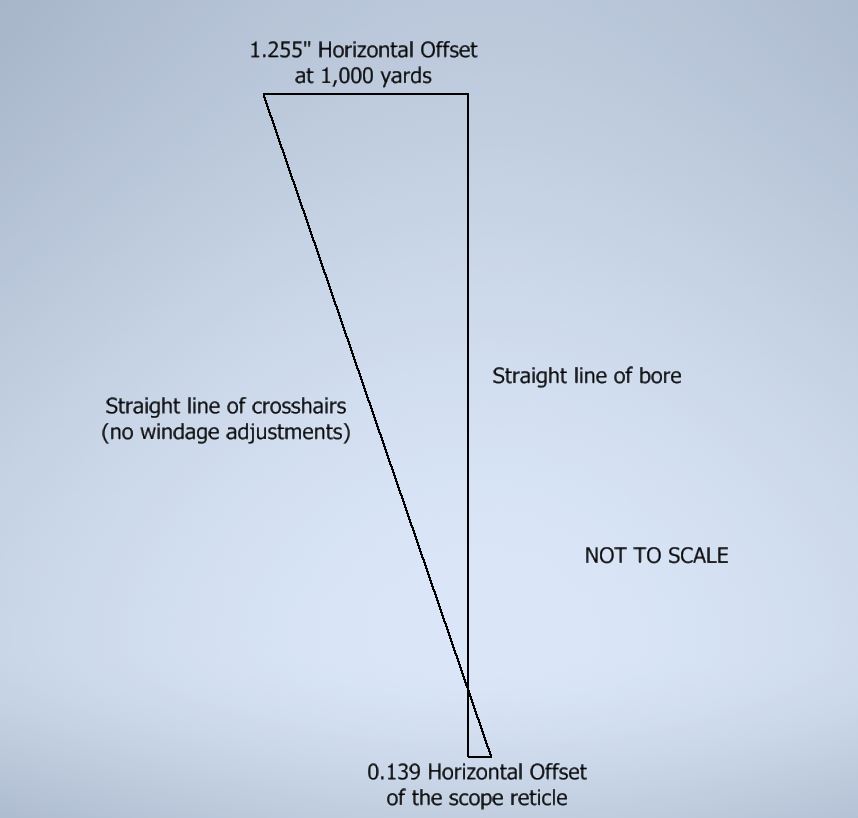
This would basically be if you could shine a laser down your bore and put your crosshairs on it at 100 yards. Then without adjusting the windage, looking at 1000 yards. The laser would be that far off horizontally.
I used CAD (so I didn’t screw up the math) to draw two straight lines. One for the bore and one for the horizontal offset of the crosshairs of the scope. The point they intersect is at 100 yards. I then just extended the lines out another 900 yards and measured it. That is where I got the numbers I posted.
I start with the Barksa Bore Site 15 Fixed Arbor kit and then check it with bore sighting laser. i level the rifle using my construction levels on the but plate screws for vertical and magnetic levels on the scope turret with caps removed. this seems pretty good to at least get close on paper, to do final adjustments at the range. this has worked on 3 vortex scopes and i just set up a Leupold freedom 3-9x50 that I’m waiting for Idalia to pass so i can finish it at the range…
Back to my suggestion of line up marks on scope and rifle action. Seems essentially the same as a plumb bob to me. The manufacturers could make very precisely placed marks during manufacturing- especially if they made a test jig at the end of line and using lasers. Seems a way to me to simplify the whole process. But to be fair I am an electrical engineer and not a mechanical or production or test engineer and all of those I work with are also involved in electronics production.
Alright guys. Hear me out. I have been one of those crazy, everything has to be level, buy every tool, type of guy for a long time when it comes to mounting a scope. I have even have lapped certain rings just in case. I think what Ballistic Brothers (BB) is correct, however i think Jim is correct too. But “how is this possible, Coyote Dentist?” You ask. I will tell you.
BB is talking about the process of mounting the scope on a rifle that is not level and then going to the range and zeroing it in at 100 yards. I think his diagram is accurate. The bullet will be lobbed in a vertical direction and the scope meets it at 100 yards and never again. If the scope was mounted directly above the bore, in relation to gravity the two would cross in 2 places, assuming you sighted it initially at a close range.
Now jim and his video are talking about holding a rifle that has already been sighted in at a distance, but is being canted at a different angle than sighted in at. When you aim at a 1000 yard target and then cant the rifle, the scope will be pointing at the same place but the bore will shoot a bullet to meet the scope, but because the bore isnt shooting the bullet in line with gravity the lob will be in a vertical and horizontal component. Not just a vertical component as in BB’s case.
I have asked Jim about this before when i noticed he eyeballed the vertical component of the rifle when mounting the scope. Unless your trying to hit a fly at 1000 yards i dont think it would make a significant difference if the scope is exactly over the the bore during the scope mounting process, as BB has shown. However from what Jim showed that if thinks aren’t level (repeatable from when you sighted in) while shooting the gun it can be significantly off.
This is the instrument i use to get the scope over the bore accoring to gravity. I also use the wheeler levels that attach to the barrell to check to make sure i am consistent as i tighten the rings. It is a great concept and i assume this tool is machined square. Oh, and i use a plumb bob.
Those are my thoughts. I’m not a smart man, but i know what love is.
For me - an un-level scope bugs me. I have leveled scopes using digital levels on rifles and scopes with tenth of degree precision. And I have slightly tweaked scopes after doing this because it looked better lined up to my brain. My brain probably wrong but the AD in me demands it.
Coyote hit the nail in the head. That’s what I was trying to explain. My real avid scope leveling kit basically does that same thing, lining up the scope and barrel just like the tool he posted. There are just too many levels involved. I think I’ve decided that I am going to custom design and 3d print something similar that I can put one digital level on top of but also see through. This way I can look through it still to use a plumb bob.
This has been a good discussion with random people. It’s made me think of things I haven’t thought about before. I appreciate it.