Just watched this week’s episode of little crow Gun Works load development. I’m enjoying the series. However I’m not certain whether I will incorporate some, or all, or none of his techniques into my next development. Thankfully I don’t have anything on the radar right now that needs to be made up.
But while I’m watching this I’ve got a little devil on one of my shoulders going " he may have gotten the exact same results if he had done the Hornady method" the last two loads I developed in late 2024 both used the Hornady method and I got what I felt like we’re acceptable results with a lot less fuss and muss.
So i suggest:
Two Guntubers with reloading experience, and equipment.
One rifle to share between the two
Ample supplies of single-lot brass, primers, and bullets. We choose one specific bullet and it should be a hunting design.
GT #1 does load development using the Hornady method. They pick which powder they want to use and what charge. GT #2 uses a more old school method like lcgw.
Then test to see who made the most accurate load, and who used the least amount of components getting there.
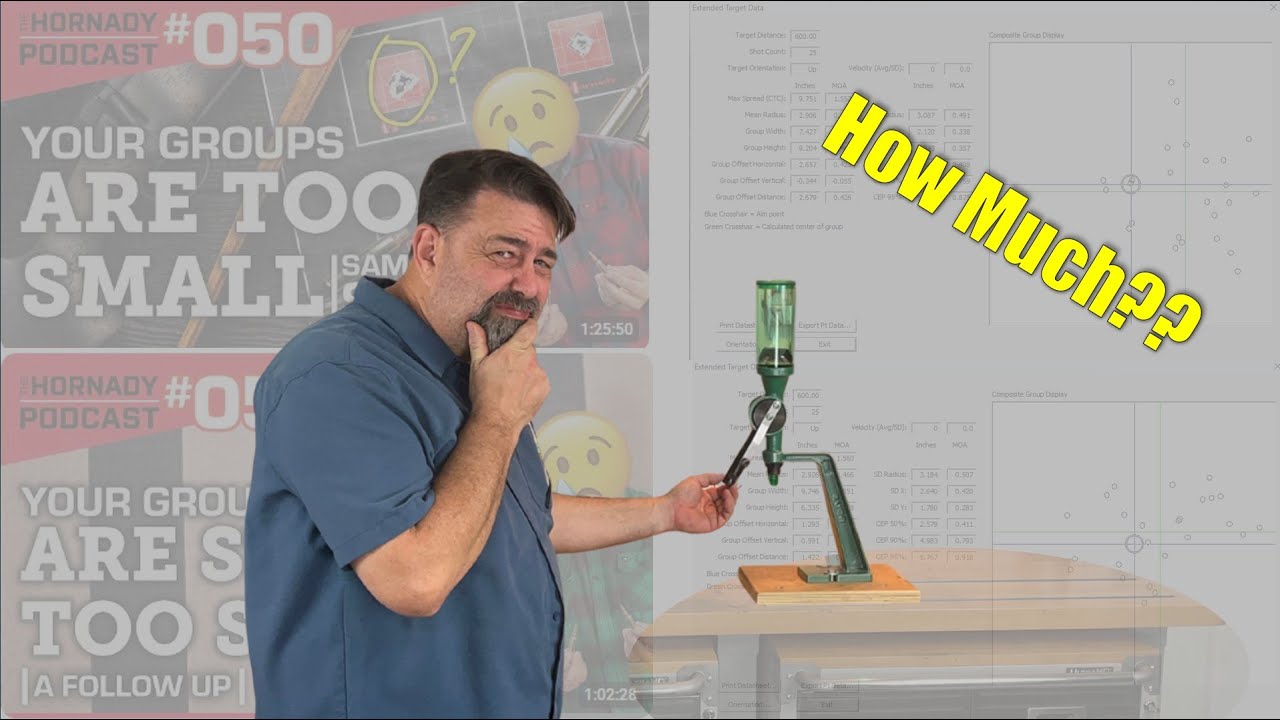
I’m gonna do a podcast episode about this. I have strong opinions on this topic that differ from what Little Crow does. I think some of their ideas make sense and are what has been taught for years, but aren’t statistically valid.
I, too, would be interested. Tim (Little Crow) says velocity nodes are BS and I totally agree. This week he used 3 shot groups to find consistent point of impact among consecutive groups and says if you don’t have this consistent POI, your groups might stay small but will shift from day to day. That’s what I’ve had happen with a 7mm load using Nosler Ballistic tip 120 grain. Now that I’ve drawn an elk tag (Colorado Unit 201), I’m ready to develop a load using 140grain Accubonds. I have Varget and N150 powder and am wondering if Little Crow Tim’s method for choosing powder is the best way to go. And as a math nerd, playing with Gordon’s Reloading Tool is super fun.
Maybe, maybe not. Don’t know unless you test and see.
But if one load development method leads to significantly better accuracy than the other, or, if one load development method gets things done with less than half the components being used, I think that would be interesting and important to know.
Bullet points if you don’t want to watch for 1 hour.
Guy tests several of the classic load development strategies (OCW, flat spots, ladder test, etc, etc) then pits the load he got from that vs what he got using the Hornady load 1gn below Max and >20 thou jump. 308 with Sierra Match King. Final test is a large 25 shot composite group
End result: no difference between the methods in terms of accuracy and other metrics.
I should mention this is now the third video / blog post / article that I have seen where the Hornady method proves to be equally good as old school methods, but with significant less component usage. Maybe there are other videos, Etc that have the opposite conclusion but they haven’t come across my recommendations, Etc yet.
Setting your expectations and goals certainly plays a role in that.
The first several loads I developed for my hunting rifles I focused on making adjustments and adjustments and adjustments trying to get the group as absolutely tight as possible. My last couple of load developments were using the Hornady method but I also changed my goals. I was just looking for something that gave me 1.0 or less Moa. And that was using three shot groups, averaged over 15 to 18 shots. I was not going to chase Tighter and tighter.
I am happy with 1 MOA for my hunting rifles but I want the ES to be less than 30, so that is where I get into adjustments and more adjustments and changing powder/bullets.