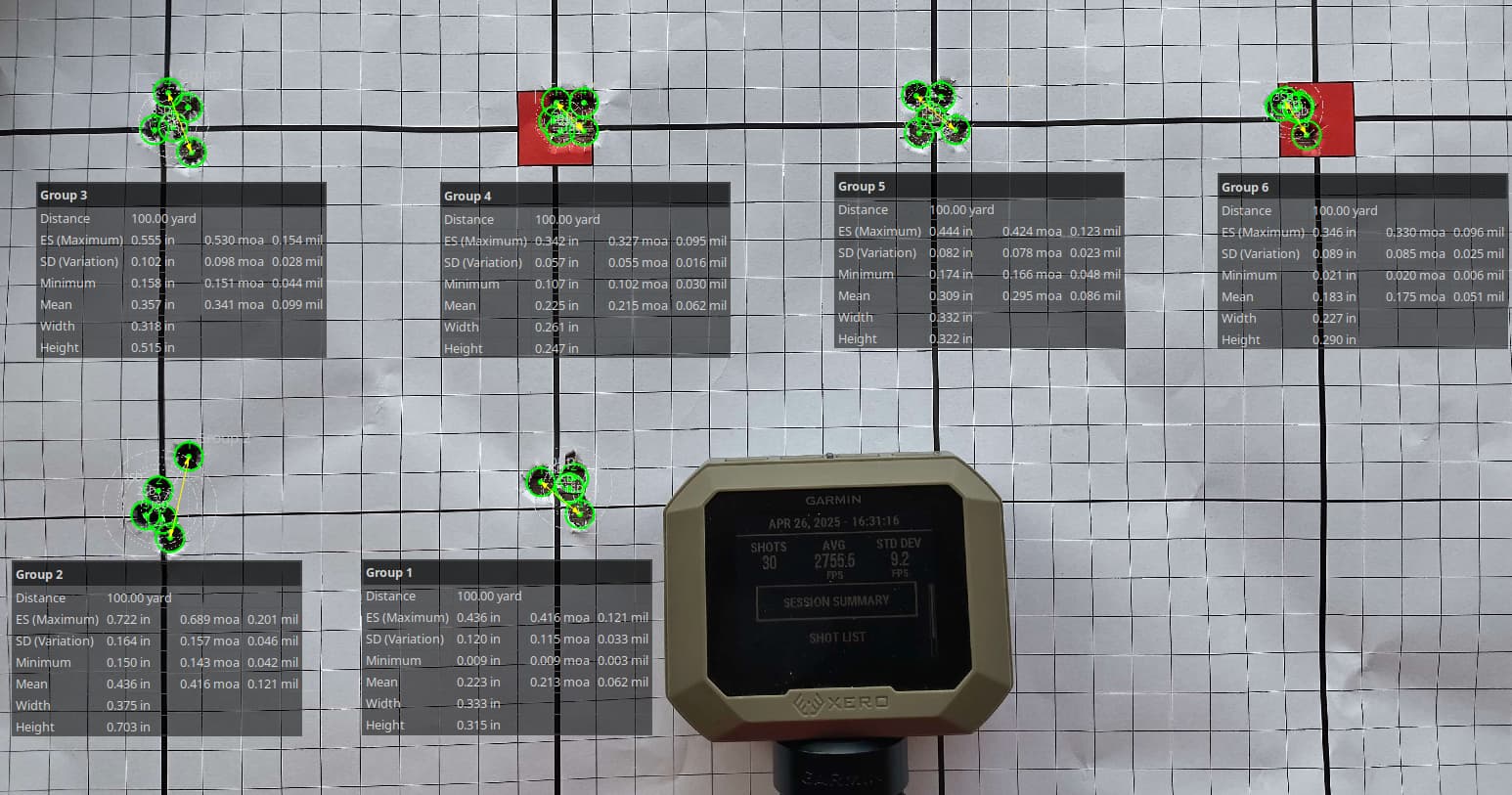
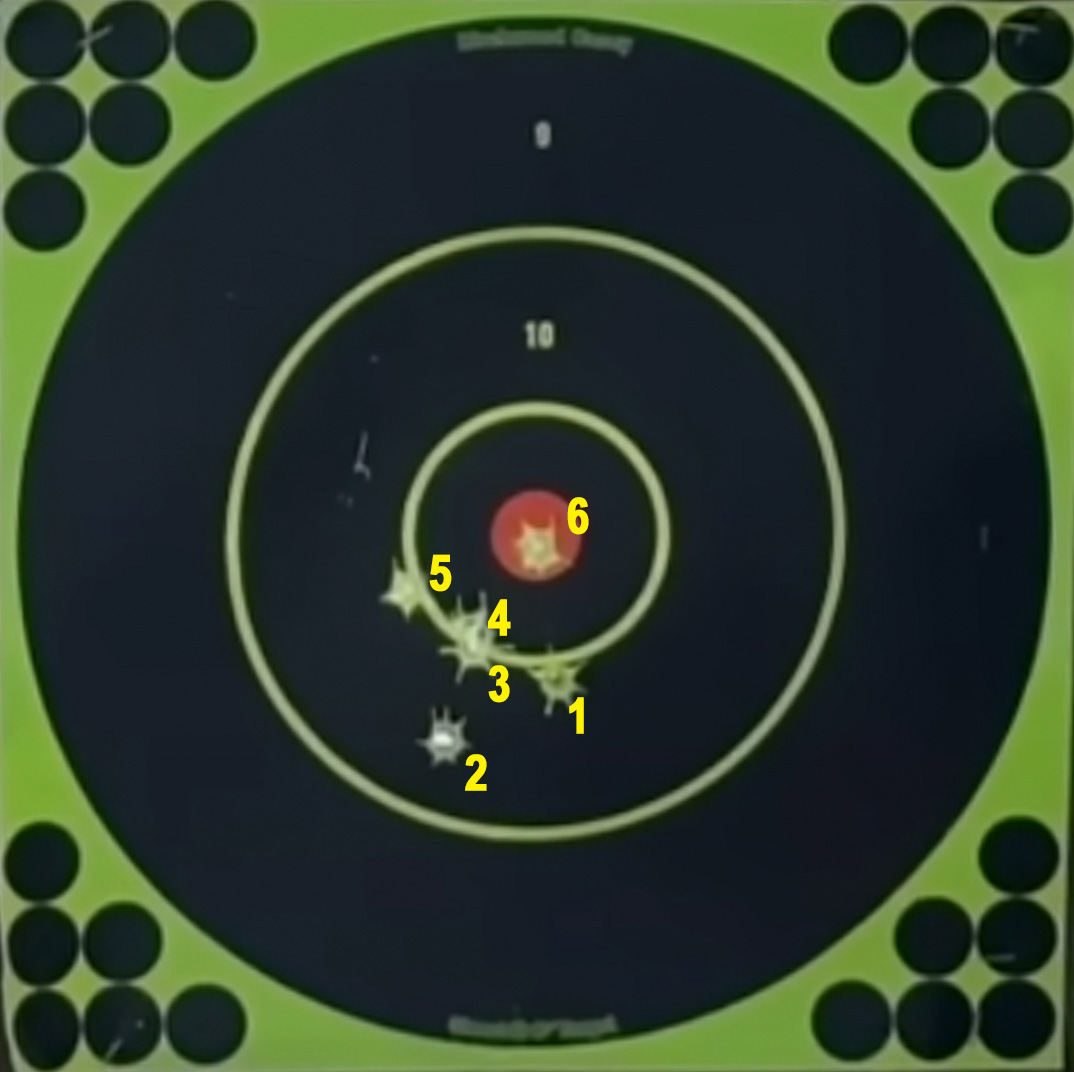
Here’s a simple example of why averaging 3-shot groups to determine accuracy (actually precision) can give you a false result.
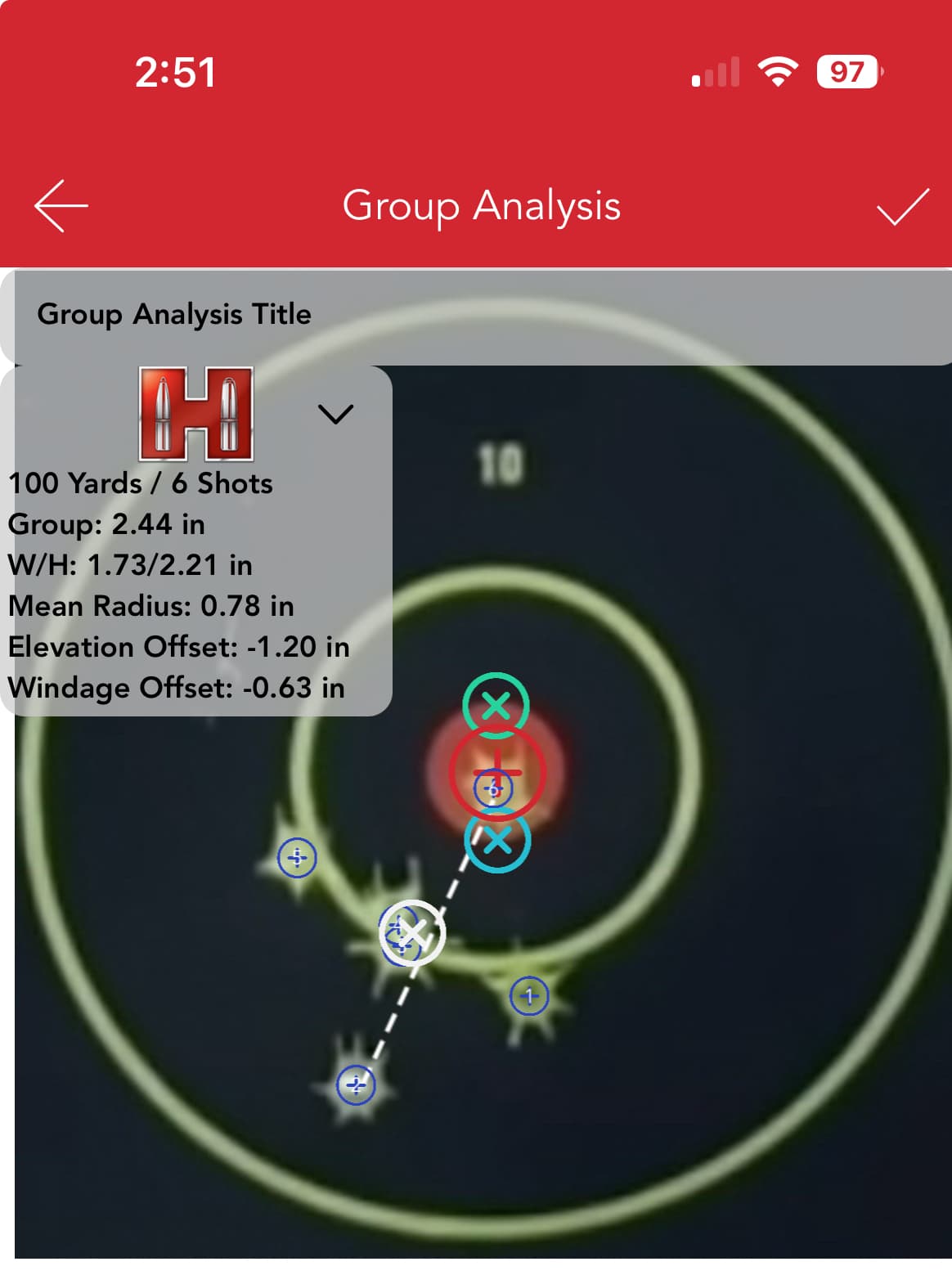
Six shots .30-30 @ 100 yards.
Group 1 = 1.43 in
Group 2 = 1.54 in
Average = 1.49 in
Actual = 2.44 in
Averaging group sizes is only really valid if the centers of the groups are in (or very nearly in) the same spot. The further apart the centers, the greater the error.
When I want to shoot a large-volume group (say, 20-35 shots) to get a statistically valid estimation of accuracy (precision), I still shoot multiple groups b/c it’s hard to see individual bullet holes when the bullseye is shot out. I shoot 3- or 5-shot groups and then overlay the targets graphically to produce a single image with all the bullet holes marked
I’m curious, statistically, why the centers of the groups need to be in (or very nearly in) the same spot. Why would the centers of the group matter when you are measuring variation in the distance between the constituent shots of each group?
You’re right that averaging 3-shot groups will not tell you the total dispersion of shooting a group with more shots in it. On average, a 3-shot group is 20% smaller than a 5-shot group.
But you could say the same thing about 5-shot groups. A 20-shot group is on average 35% larger than a 5-shot group.
So you do need to be aware of what percentage of the shots will fall into that size on average. But the average you build off is more accurate by taking five 3-shot groups than a single 15-shot group if the number you take is only the extreme spread. More data and better integrity.
Might or might not be an issue, esp with modern rifle and ammo manufacturing processes & tolerances, but you don’t know til you know. If you make a bad assumption, you could lose a match or lose a wounded critter.
Put simply - if you fire several 3-shot groups and just average the MOA measured on each group - say 0.88 MOA, you’re essentially assuming any future shot has a high chance of impacting within 0.88 MOA from your point of aim (POA). If each of those groups was not roughly centered in the same point of impact, that “high chance” is in question. Just look at the distance between the two furthest shots in those size shots. The next shot (or the first shot in the woods next Saturday) could land anywhere in that net group.
Take a piece of paper & mark an X for POA. Poke two three whole groups with a pencil but center the first group 0.5-inch up and left of the bullseye and center the second group 0.33-inch due left. Make the groups as big or small as you want, try to make them the same size or don’t; doesn’t matter. Average your two groups and compare to the size of the net 6-shot group.
Try it next time you go to the range. However many groups you shoot, whether 3-shot or 5-shot, average the group sizes, and then overlay the targets to measure net size over all the groups. The latter will be larger, it’s just a question of how much larger. On any given day at the range or afield, the next shot you fire could land anywhere in that larger net group; it could land near the edge of that group despite your best efforts – breathing, trigger squeeze, etc – to put it right on point of aim. If the variation is very small, nobody cares. Again, you don’t know til you know. I’ve tested ammo in a rifle where one brand looked better until I overlayed the groups and then another brand turned out better.
If you’re going to shoot multiple groups, might as well at least take note of not only the shot dispersion within each group but also the group dispersion so as to understand better the true, statistically reliable grouping capability. Again, any given shot could hit at the edge of that net group. Not worth losing a match over wrong assumptions, definitely not worth losing (or wounding & losing) a deer over it.
PS - Hornady put out three videos that explain this in excruciating detail in terms of statistical validity of groups size & group averaging to determine accuracy / precision, but it’s about 3 hours of viewing if you watch all three (due to much discussion, not long-winded statistical dissertations). Podcast / YouTube episodes are #50, #52 and #99.
Sorry, that was a long-winded reply. here’s a much simpler version. say you shoot three groups that averge 0.8 MOA. assuming you’ve found the extreme spread for that rifle-load combo, your next shot will most likely hit within that extreme spread but could be close to or at that extreme spread. If the groups are centered approximately in the same place, no big deal. But the greater the dispersion of the group centers, the greater that extreme spread, and the further that extreme spread from the average MOA measurement of your individual groups. And the variation becomes more problematic the further the shot. It’s good to know what that group dispersion is lest you make a bad assumption that results in a lost match or lost (but wounded?) game.
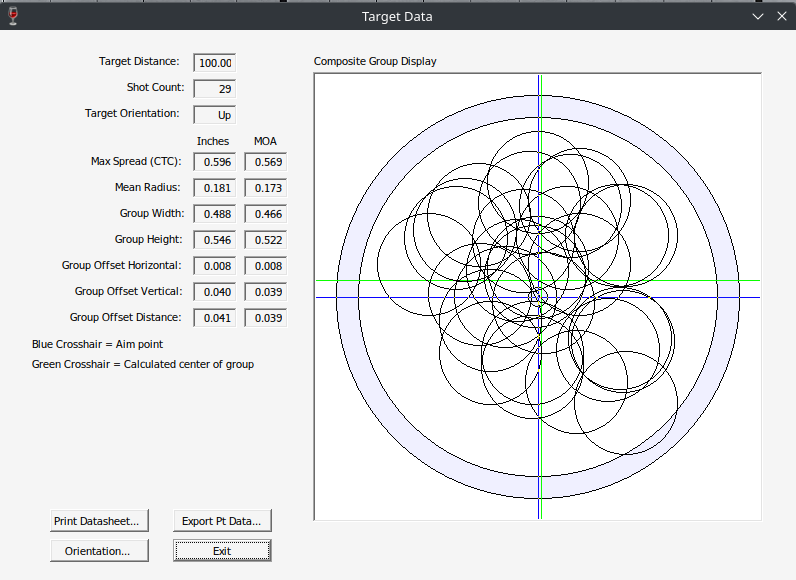
Short answer is no - use software to make a composite group based on point of aim (not centers of each individual group as those can vary wildly with small sample sizes).
OnTarget TDS is the only one that I’m aware of that does this; however what you can do is use GIMP or photoshop to overlay multiple targets over each other in partially transparent layers and then use any software to build the resulting group (which is a PITA, and I’m suddenly realizing that this feature is kind of rare).
This is an example of what it does (yeah I removed the one flyer ):
Thanks. I’ll check that out. I was under the impression that they had gone out of business.
Going back to the original question, in my opinion:
figure out what the question is you are trying to answer, what is the best test to give you that answer, and can you actually do anything different because of that answer.
If you truly want to know what a 30 round, 50 round, 100 round cone of fire is for your gun, then you’re either going to have to shoot a large group like that or several smaller groups and then overlay as described above.
I personally think that would be very cool to know. However, I don’t know what I would actually do with the information other than filing it under the “that’s interesting” part of my brain. Yes, could certainly be used to help adjust scope zero. I will say that I initially started off Hunting using a one shot zero, then moved to a three-shot zero but more recently have switched to a 9 shot zero. The nine shot is treating me quite well and don’t really feel like going longer is going to make that much more of a difference. At the current time I don’t know what looking at a 30 round group would do for me in terms of adjusting something in terms of my hunting or shooting strategy.
Heck, I’ll also love to know a true Cold bore zero. Another Western Hunter on Youtube does this where he goes out first thing in the morning. He is gun and ammo have been kept at outside temperatures all night long. He shoots at first light as that’s when most animals are harvested. One cold bore shot. Packs everything up and goes home. 24 hours later repeats the process, using the same target. Does it for three or five times and now has a true idea of where the gun is going to shoot when it’s cold.
But I’d also want to know what my gun would do with rapid fire. Three shot group for magnums, five shot group for smaller calibers. You never know when you might need to do a quick follow-up shot, or in some circumstances depending upon what you’re hunting you may have several animals that you can Harvest at one time. It’s nice to know if and when the Gun starts throwing shots off of where you’re aiming.
More information is always great, but just have to decide is it worth the time, components, and wear on the material to gather that information.
Thanks, now I get it. The point is to understand the probability of where a single shot from that rifle will likely hit, so the overall dispersion is important, not just the variation in a single group.
For a hunting rifle, that is a reasonable way to do it. I do the same thing, but shoot 3 shot groups each time, keep the target, bring it back on the next trip, and shoot it again. May be the next day, even the next week. Doing it a different temperatures during the day also to see if anything changes with that. It is kind of tedious, but it works.
 ):
):