I was an MOA guy 100%. Then I bought my element Titan in MIL by mistake. Happy mistake. It’s so much easier to understand, for me at least. I suck at math, so that’s probably why. But, when you’re on an animal it doesn’t matter if it’s MOA or MIL so long as your zero’s and your dope is accurate.
Yes, that has been the case for some time for some companies. Just check the description closely because I haven’t seen a mismatched version in a couple of years.
I am not a mils person. I do think in yards, feet and inches. The precision of moa is fine or better for hunting ranges. I can tell you that a deer kill zone is 2 moa at 400 yds. It is 3 moa at 300 yrds. Coverting moa to inches is easy. I am not saying one is better than the other but if moa was not as good or better why would the vast majority of scopes made and sold be moa for hunting? And of course the opposite for shooting sports. The fact that the optics people do
both says it all - neither one is better than the other.
Well i have an older luepold mark 4 with a mildot ( milling) reticle and moa turrets …
Problem solved.
Thank you! I haven’t bought a scope in a very long time, I appreciate the help! Have a great weekend
Yeah, in my opinion it’s quite a nice step up in glass quality.
Watching Cortina’s KYL today. So he talks about the targets in terms of moa for mil scopes. Why not talk about the targets in mils? He says adjustments in mils to the shooters. I see this a lot where targets are moa and groups are moa but scopes for comp are mil. Isn’t this confusing? Why not use mills for everything? Does anyone do load development in terms of mils for groups? What am I missing?
Not 100% sure of this reasoning for others, but for me I say MOA on the target becuase a MOA at 100 yards is 1" and I am kind of programmed in my thinking about 1" at 100 yards. 1 mil at 100 yards is 3.6" or 1/10" mil is .36". Either that is too big or too small for practice. So I stick with MOA on my targets, but I use a MIL target when I am sighting in to make that process easier.
Mils are more useful for estimating range with your reticule and are easier to do mental math with for wind holds.
Target size in moa is a consequence from most ranges still being set up in yards.
I use a range finder for range estimating. If out to 300 no ranging needed. The longer the range the more time I have to set up on an animal. I guess I should learn how to estimate mil corrections based on information based on inches - ie 2 moa target at 500 yards and shot high by two targets. I instantly know 3 moa correction to center of target. Not sure how that works in mils. If I either tell you 10 inches high or two targets as a relative reference- how is that converted to mils. I need to study.
You measure with either your reticule or a spotting scope that’s also in mils. Converting to/from angular measurements is completely unnecessary.
So I can do that with an moa scope it seems as well. How many mils is a deer kz at 200 yards? I do not own reticled spotting scopes or more importantly binoculars. I do own range finders.
But I will study more. Still wondering why they measure target size and group accuracy in moa if using mils as your basis for ballistics. All the rifle manufacturers claim sub-moa groups. Do any claim a sub-0.25 mil groups?
I prefer MOA for all applications, because that is what my mind understood better when learning about both. What I am not picky about is ffp vs sfp. I use both for hunting, but prefer ffp for target shooting long range. I think the most important thing is to pick the application that makes the most sense to you, learn it well, and be content with it. That’s how I feel about it at least.
MOA was far more popular in the past so its basically the language we all have used and again, for most of us its easier to comunicate in MOA knowing that 1MOA @100 yards is 1". We think in 1" groups right?
Honestly, I wouldn’t get too caught up in it if you’re not using a spotter. MOA or MIL matters if you’re using a spotter, but otherwise it really doesn’t.
For me, thinking in 10s is easier than MOA and that math, like 4 clicks at 100 yards and 2 clicks at 200 and 8 clicks at 50 (I am not even sure that’s right). MILs are simpler to me. But when I talk about my groups, I’ll say MOA because that’s the language we all know.
Ok but me not understanding is how you know how many clicks to move. If you see you are 10 inches off at a range - how does that covert to mils?
I am deer hunting with a suppressor and I shoot low at 600 yards. I say given the size of the animal then I guess I am 10 inches low say for a deer. On moa scope i know that 10 inches is 1.5 moa about. One moa plus 2 clicks on the dial and I am there as fast as I can spin the dial. I can even count 6 clicks without looking at the dial. I feel like I am really missing something. What would be the equivalent action in mils? I feel like a ludite.
You’re making it seem way harder than it is. It’s all just simple arithmetic that most people should be able to do in their head and holdovers/dialing you can keep on a dope card.
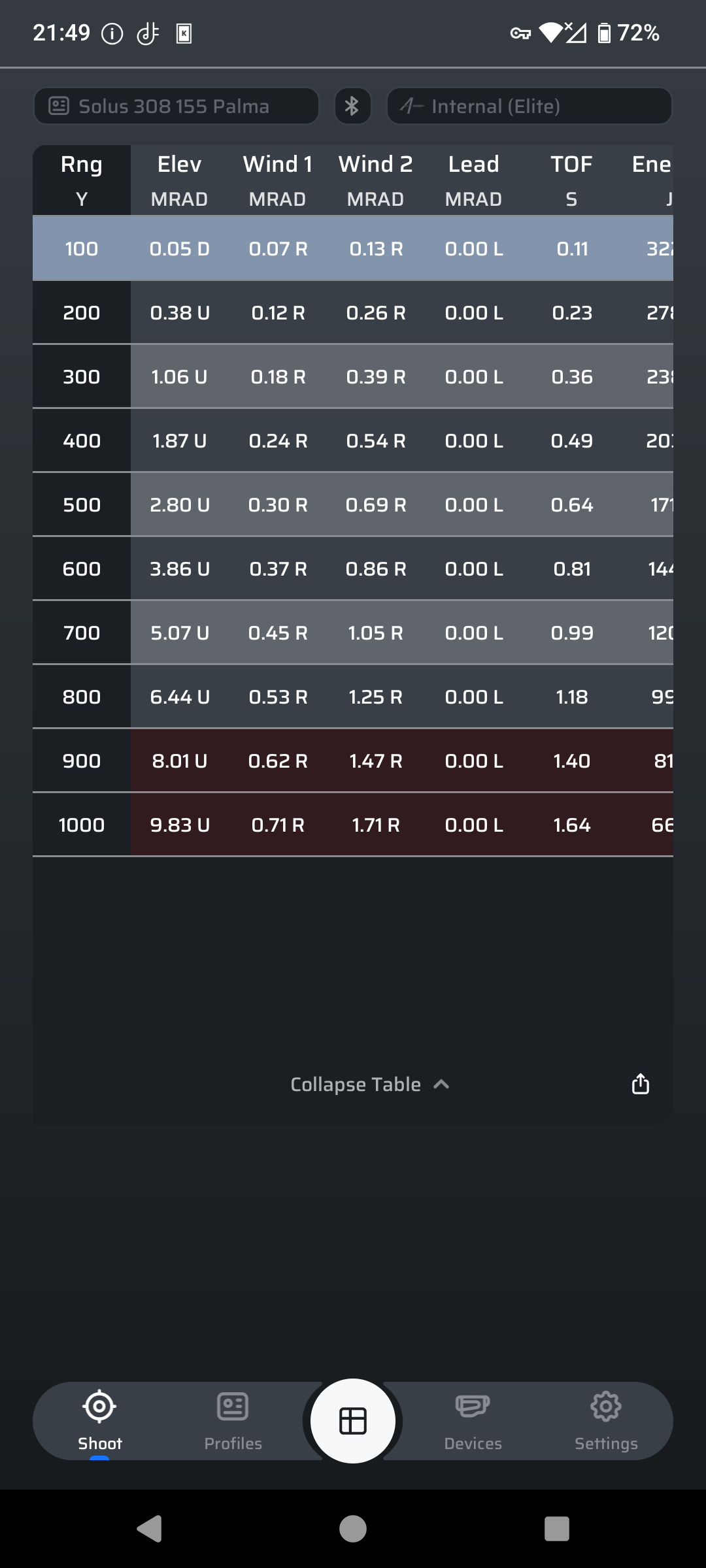
Sorry if it feels like going in circles here. mainly for if you miss. Same thing for moa. range , dial and shoot. It seems I would trust my ranging from the laser than I would from a reticle to start.
But my question was not answered.
I shoot at a prairie dog say 4 inches wide. I miss left due to wind 2 dog widths and range is 400 yds. With an moa reticle I would move over 2 dots or 2 moas on the scope.
How do I do this with a mil scope? 8/(4*3.6) =0.556 so I dial over either 5 or 6 clicks? or hold over between 5 and 6 lines in reticle?
Now if I was in Canada and that prairie dog was at 400 meters and was 10 cm wide and I miss by 20 cm then I would adjust 5 clicks.
But I don’t live in Canada. And ranging is in yards as in your card. Just like I don’t cook with grams or drive with kilometers. I get why military uses it. But for me when ranging in yards MOA seems easier. I get there us a rounding error that compounds to be about 5” at 1000. But for hunting at reasonable distances - to my mind moa seems easier. Some say well you don’t have to memorize 3 numbers. only 2 for initial ranging. ok fine. But on a yards range with a miss I can know my adjustment very quickly without thinking about it and without needing to look at a range card using moa. specific use case that is not competition I get it. Not convinced that mils are easier for hunting unless you switch to metric system. Thanks for listening- or reading.
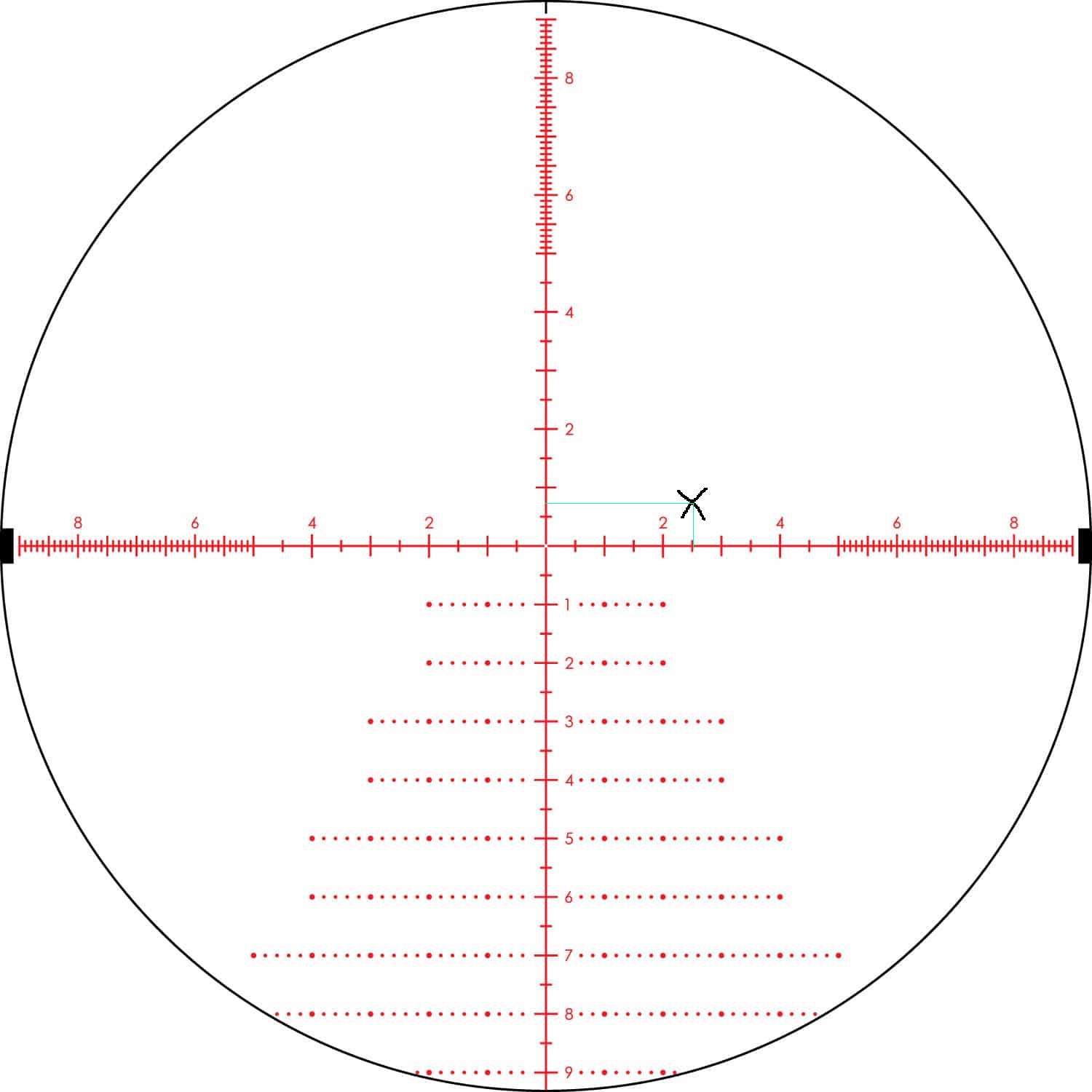
Impact goes there, come up about .7 and 2.5 right.
If you’re on a flat range with known distances and you’re zeroing, grab your target, figure out the center of the group and then use:
adjustment in mrad = (offset in inches/distance to target in inches)*1000
So for example if you’re 2 inches low at 100 yards - (2/3600)*1000 = 0.55 mrad.
On most scopes I can just spot my target at 100 and then use the reticle to measure without ever worrying about how many inches its off.
Ok this is the answer to the question I have been asking - how was it done. Thanks. That is pretty simple for sure. A picture is worth a 1000 words!