I have an awesome little rifle in 6 creed. It is a Bergara wilderness Sierra, (this is the exact rifle that ranked 12th in the RAD) With my hand loads, Ive got a 108 ELD-M going 2890 fps out of a 20 inch barrel. Its a beautifully accurate rifle. I do plan on keeping my shots inside 400 yards. But, if the chance comes, with perfect conditions, I would be comfortable out to 600 yards.
Any cautions I should take, maybe switch the bullet to a true hunting bullet, or am I just overthinking??
I do think it would be nice if Hornady would offer the ELD-X is more grain weights, but I think you’ll be fine. The ELD-X has a thicker jacket that might get you a tiny bit more penetration, but you have a load shooting excellent that has killed a lot of big game. Mule deer are thin skinned and should die easily to almost any bullet.
Sierra is coming out with a new 116g TMK next month if you want to try something new. It’s what I would pick for hunting if I had a 6 CM.
The process and reasoning behind why they can’t call some bullets “hunting bullets” is kind of fascinating and has some political/legal ramifications.
Yeah, the whole hunting Bullet versus non-hunting bullet thing is an interesting discussion.
Seth from Hornady was on somebody else’s podcast that I listened to. He said the reason they don’t recommend the eldm for hunting is that when they tested it, it had an unacceptably high failure rate. No more specific than that. But you’ll find an absolute ton of people who have used them successfully on the internet.
I’d like to try Sierra Bullet sometime. I purchased some of the Harvest collection for my 7 mag, but they didn’t shoot with a darn in that thing so I’m not going to use them. Have to figure out what platform I would try to use them in, most likely with a hand load.
How much energy do you get at 600 yds? 1000 ft lbs estimated to kill a mule deer. I set my limit at 1500 which I get at 600 yds with my 6.5prc using 156g Berger EOL bullets.
I had just read a post about ELD-M variability, but was having a hard time finding it again and seems relevant to the discussion:
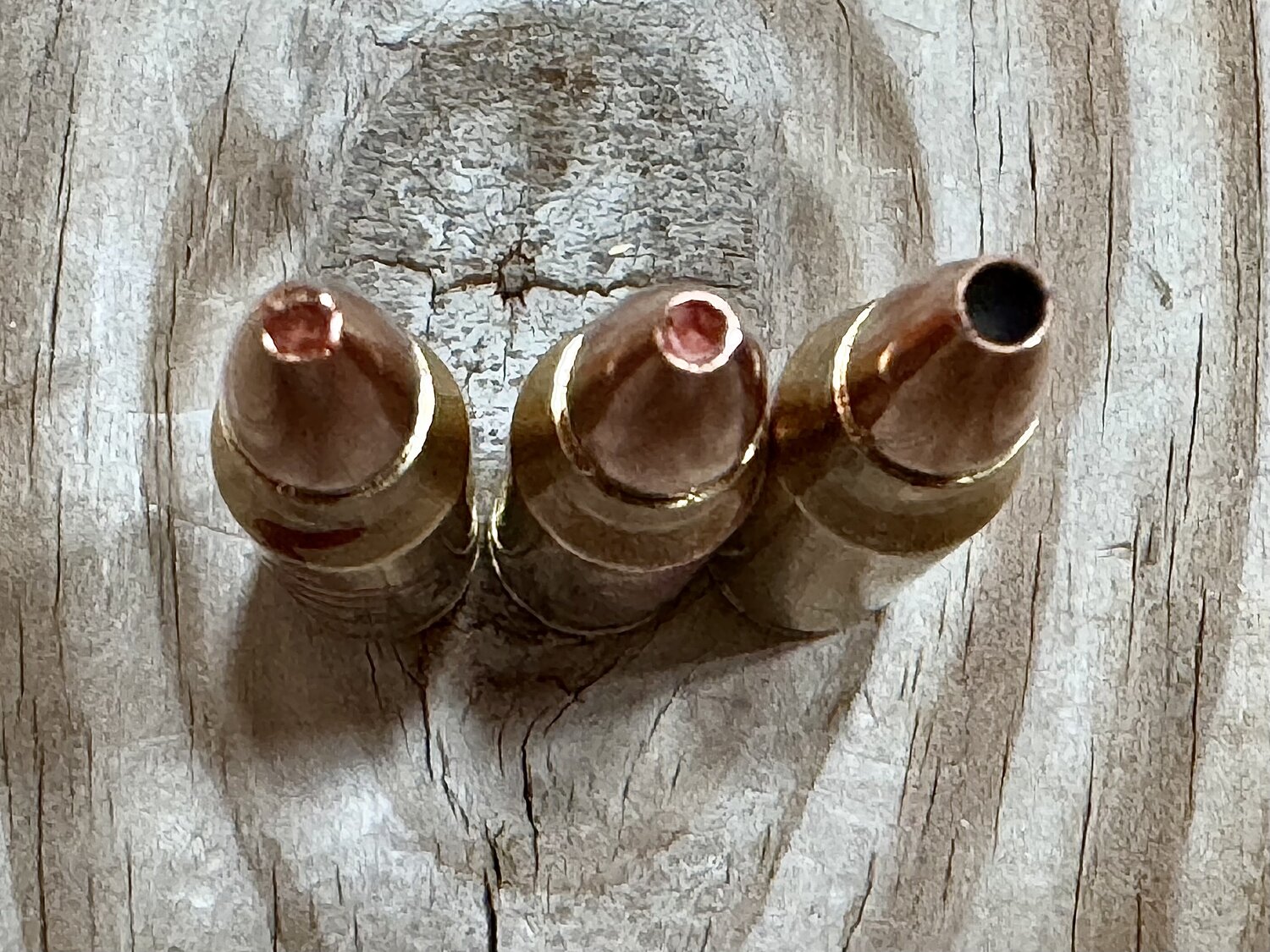
“The ELD-M have long slender/pointy ogive (some more than others), a tiny nose opening compared to TMK’s and smaller than ELD-X’s, and the jacket is thicker at the front portion of the bullet. Lead surrounds the shaft of the tip nearly all the way to the top, and the tip itself in the ELD-M (and X) is brittle and tends to break off right at the nose as below (168gr ELD-M left, AMAX, 178gr ELD-X right).
All of that put together, if one understands how bullets upset, it shouldn’t be hard to see how you can get a weird one that the tip breaks off, the nose pinches over just a bit- and you are left with what is functionally an FMJ. This also tracks with impact velocity as the issue seems to show the most below 2,200’ish.
Again- this isn’t to say that ELD-M’s are “bad”. All bullets have variability- lots/most hunting bullets do the same thing at a higher rate- hence the reason that I generally don’t use “hunting” bullets. Just that the ELD-M’s show a behavior that AMAX’s did not, and overall are usually not nearly as destructive as AMAX were. There is a price to pay for super aggressive ogives and the highest BC and harder tips that don’t melt. This is why… (the new) TMK’s don’t chase the absolute edge of possible BC- just make them decent and keep the construction the same.”
Yeah, variability is definitely a thing with bullets.
A few years ago I scored a rifle tag for a Kansas unit where I have a relative. He invited me to stay at his place and said hey let’s avoid the TSA and you can just shoot one of my guns. He had a 7mm magnum with 160 accubonds loaded by custom company. I got there, verified that the zero was great and indeed it did shoot a good group for four shots.
The Outfitter that I was hunting with put me in a stand that was basically designed for archery. Their archery season is several months long where is the rifle season is only 10 to 14 days. Sure enough, the buck I was interested in, a nice 10 point, walked out right at 30 yards from me. The Big Challenge was getting the rifle on him without making any noise or him even seeing me. Perfect double lung shot. Exit was about the size of somewhere between a golf ball and a tennis ball. He bounded strongly for three leaps and then crashed and died where I could almost reach out and pet him from the stand.
2 months later my cousin used the exact same rifle, the exact same box of bullets, one bullet further into it on an average size doe right at 100 yd and the darn thing penciled straight through. It ran for 100 yards barely bleeding and thankfully he had a tracking dog or else he probably would have lost it. 100 yards is certainly well within the effective range of a 7 mm Mag.
I definitely want to try some of those Sierra bullets again. Hopefully I can find a gun that likes them.
Give a listen to the smaller caliber podcasts from the exo guys. They shoot 108eldm’s from 16 and 18 barrels out to 600 yards on deer elk caribou moose bear. No problem for mule deer, I just built a 6 creed and am using it for deer bear caribou. What powder and charge did you find worked well? I found that 43gr of h4350 shoots great and getting 3000fps from my 18 inch barrel with no pressure signs. Still nervous that I’m way over pressure…
I am trying really hard to back off the pressure, As I was using hornady brass before. 43 grains is a lot of powder, Id be interested in what brass you are using, I am using h4350 but I just got new brass from peterson, which will handle pressure better than that hornady stuff. (I hope) Im just going to take my same load from my hornady brass and see what happens.
COAL: 2.800
108 eldm
h4350 40.8 grains
This weekend Im going to get out and shoot a box of factory 108s, then my prevoius loads in the hornady brass. Then the New loads. Check back on monday!
I am using unfired Peterson brass. I’ve now loaded up some 2nd firings but haven’t shot yet (trying 2.79, 2.80, and 2.81 coal). It’s certainly possible that I’ll see pressure now that I am shooting a piece of brass that is much closer to chamber dimensions, but may see more velocity too. We will see! Accuracy at 43 grains has been excellent. Steve from exo shoots 42.4 grains of h4350 and 108eldm at 3000fps, but he says he has a fast barrel.
Since we all seem to be chasing that perfect load that lands in the same hole consistently I have a question for the smart guys or at least those with a different perspective. I find getting identical seating depths problematic whether I use COAL or a Hornady comparator. From my experience when using COAL, the ballistic tip can vary the length as much as .003, often the same can be said when using the comparator on the ogive.
I’m pretty much old school and my equipment demonstrates that, RCBS, Lee and Lyman presses with RCBS, Lee and Hornady dies. I began using the Hornady micro seating dies recently which I like but still get up to .005 variance at times even when using a BTO comparator insert. When I read where you seat at 2.799, 2.800 and 2.801 to test I wonder what I need to do differently to get 2.801 every time I pull the handle or am I overthinking this issue?
I’m definitely not the end all be all expert so take this with a grain of salt.
Note that the values above I am varying are hundredths not thousandths. (2.79 2.80 2.81) rather than (2.799 2.800 2.801). I agree, it’s better to measure off the ogive than the tip for sure due to bullet length variance. I measure my CBTO in order to repeat loads but I record both values since it’s usually easier to communicate COAL rather than CBTO on forums. I also see variance in both COAL and CBTO. In my notes I list the range of COAL’s or CBTO’s so that when I repeat that load I make sure I’m in the same range. Looking at my notes it looks like my COAL variance is around .005 and my CBTO is about .003.
That was great insight. The second read through your post I saw the seating interval at .010 vs .001. I subscribe to the Erick Cortina approach on seating by starting at jam minus .010 or .020 with seating interval adjusted after that every .003 until a node is identified. Seems like I find one about every .010 to .015. Once I establish a consistent COAL I switch to the CBTO measurement but even then get up .003 deltas. Why that happens is puzzling especially when attempting to fine tune seating depth to a .003 tolerance.
I’d be more than perfectly happy with 0.005 variance.
Even the most high-end digital caliper has a accuracy of plus or minus 0.001. That means if the actual absolute true measurement is 2.850, the caliper May read anywhere from 2.849 to 2.851. And that’s not even starting to account for human variability.
So yeah, when I first heard of people talking about varying seating depths by 0.003, and then doing small sample sizes, I was thinking how in the world are they actually measuring these things and think they’re getting any type of true Precision / accuracy. I don’t know that Cortina actually recommends doing that anymore. Last I heard he had kind of given up on seating depth changing and just uses his tuner now.
Also, try measuring Factory ammo and see what you get. I guarantee you it’s not going to be the exact same with every single round. I talked one specific, can’t remember which one, die manufacturer and they told me that they would be perfectly happy with 0.007 variability
When using the Hornady CBTO gauge and derive a delta of .003 I will make a 3 click adjustment on the micro seating die to achieve the desired jump from the ogive to the lands for that particular round. The assumption is that delta is from ogive profile differences in the manufacturing process. At times I think I’m now rolling rat turds or trying to pick fly shit out of pepper. As Jim has pointed out more than once the basic hunting rifle averages 1.8 MOA and that will put meat on the table 95% of the time, but, that being said I love seeing those sub MOA groups as much as anyone.
Over the weekend, I found a load that seems to fit what Im looking for, Unfired peterson brass with 40 grains of 4350 and 2.770 COAL seems to have worked really well, Over 30 shots I have an SD of 13 which is plenty good for my hunting set up. The one thing Im still chasing is that absolute micro groups. At this time I am 20 years old and dont own a suppressor, But when I have borrowed a suppressor is the past it shurnk the group by about 1/4 inch. should I keep my load the same and just wait until I get a suppressor, or will the second firing of the brass give me better results??
Carter, I took your lead and opened a new box of Nossler 6.5 CM 140g and ran all them through the Hornady comparator on the calipers. To my amazement they varied .010 from shortest to longest, while the majority were somewhere in the middle. I have used the Cortina seating method of jam -.020 to begin a test then run in segments with three to five rounds at .003 intervals. If they don’t group with 3 or 5 rounds the likelihood of getting a decent group with 20 rounds is not in the cards. It really doesn’t take that much to get 10 groups on paper and generally I’ll get two nodes with small groups which is where I then concentrate further testing. The fact that the calipers is good for + or - .001 is fine as I am not looking for an absolute measurement, just a measurement that is a benchmark for that particular round and is repeatable at a prescribed depth. On a slightly different subject, in your experience is there enough difference between the 6.5 CM and the 6.5 PRC to justify the cost other than the satisfaction of just adding another rifle to the herd? I found a new Tikka T3x in 6.5 PRC that would look really fine in one of Jim’s new Backfire Chassis and hanging on my wall. Right now my RPR in 6.5 CM is pushing 2750 fps with .6 MOA groups at 100yds.
Being honest, I have yet to harvest any animals, or even pull the trigger on an animal with any 6.5 mm.
To me there are two separate uses for a 6.5 PRC.
1 you're really trying to get that Magnum velocity. Really trying to have that modern equivalent to a 270 Winchester. Either because you're going to be shooting at longer distances, or perhaps you're shooting with copper bullets and you really want the velocity to get them to open better. You're going to need a 24 to 26 inch barrel to really harness the energy and velocity here.
2. You get a super short 6.5 PRC knowing that you're really only shooting a 6.5 Creedmoor, but you're doing it with a much shorter Barrel. That could certainly come in very handy depending upon the specifics of your blinds, stands, Etc.
If you’re hunting deer at 200 or less yards, and you’re okay with a standard length rifle, the Creedmoor is more than capable and the PRC doesn’t offer much more
Edit, that’s weird. I’ve never seen that formatting on this Forum before