Will do. I am a few weeks away from the delivery of my new bench for this and the Inline Quick rleases for It so once Its up and running im planning on working on a sierra match king 175 gr/ lapua Long rifle brass with BR4 CCi Primer and varget powder . Since this is my first time out ill load from the min up a bit for the full experience. Admittedly I have a lot of learning/ reading to to do way before I pour an grain of powder. Lucky to have this forum to toll me how m=not to blow my self up 

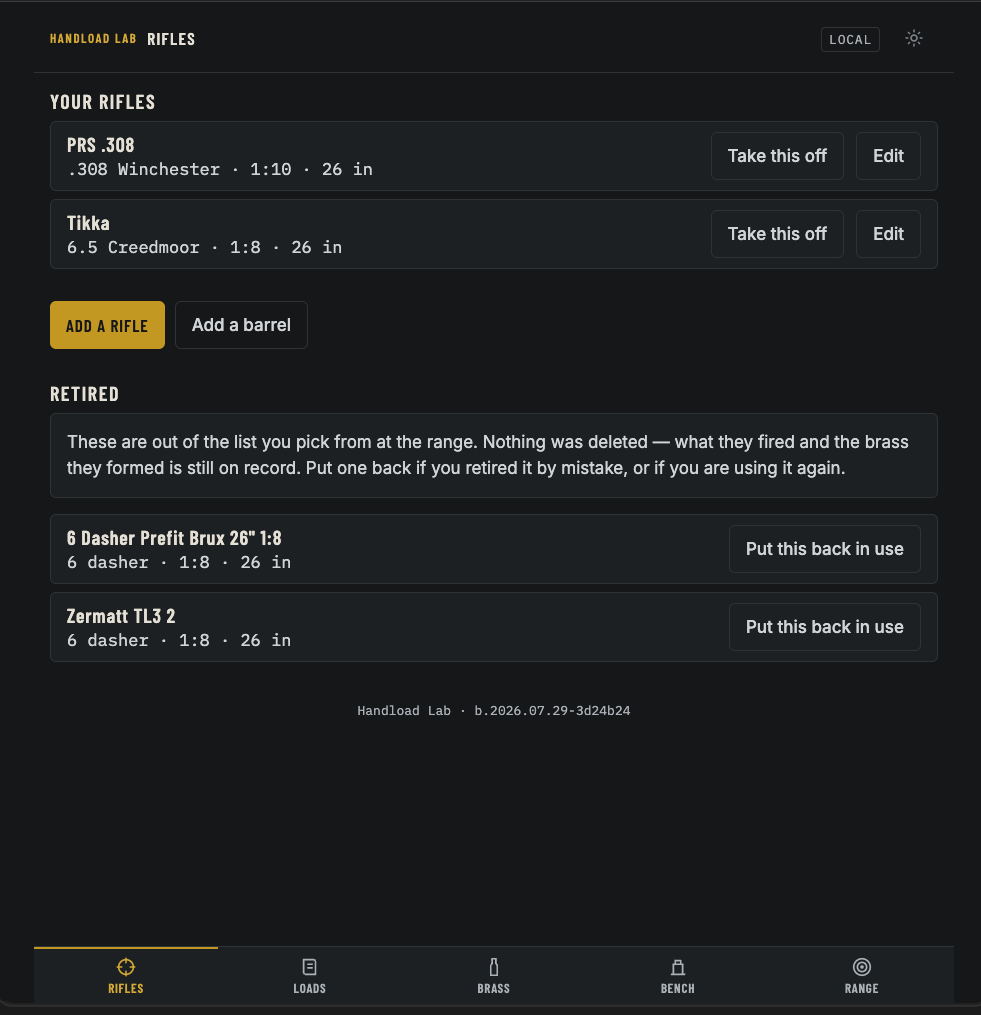
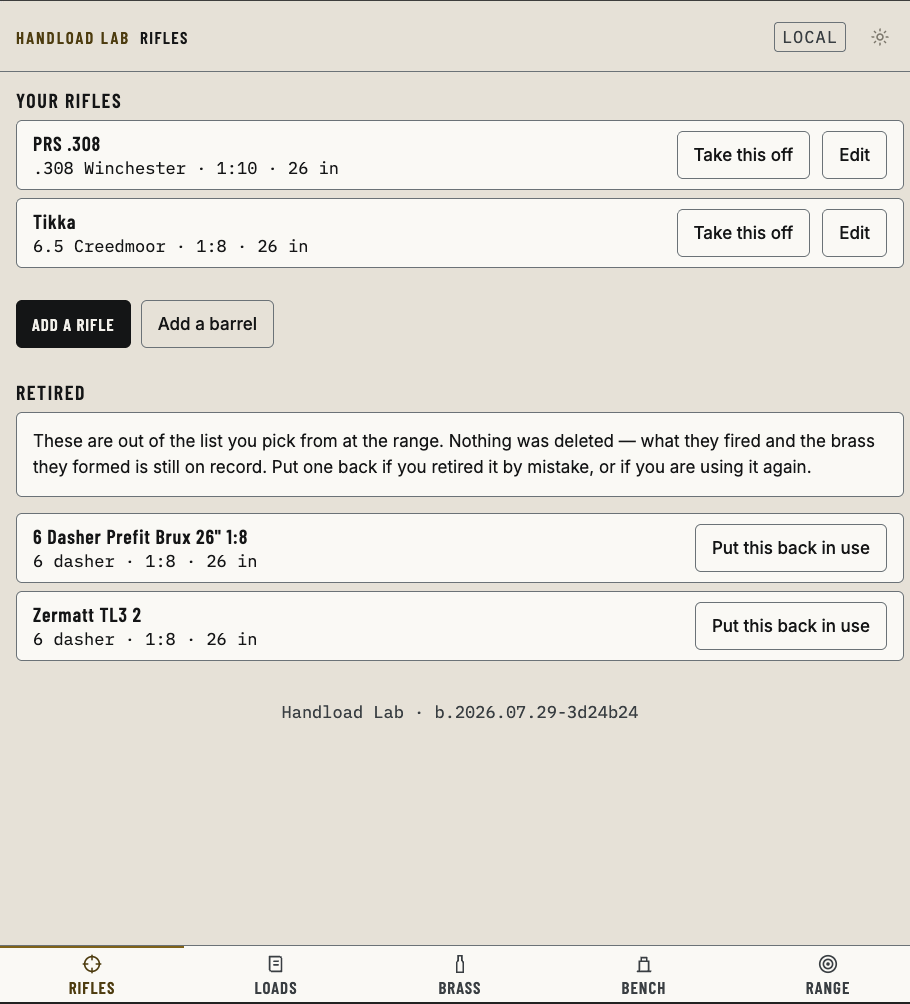
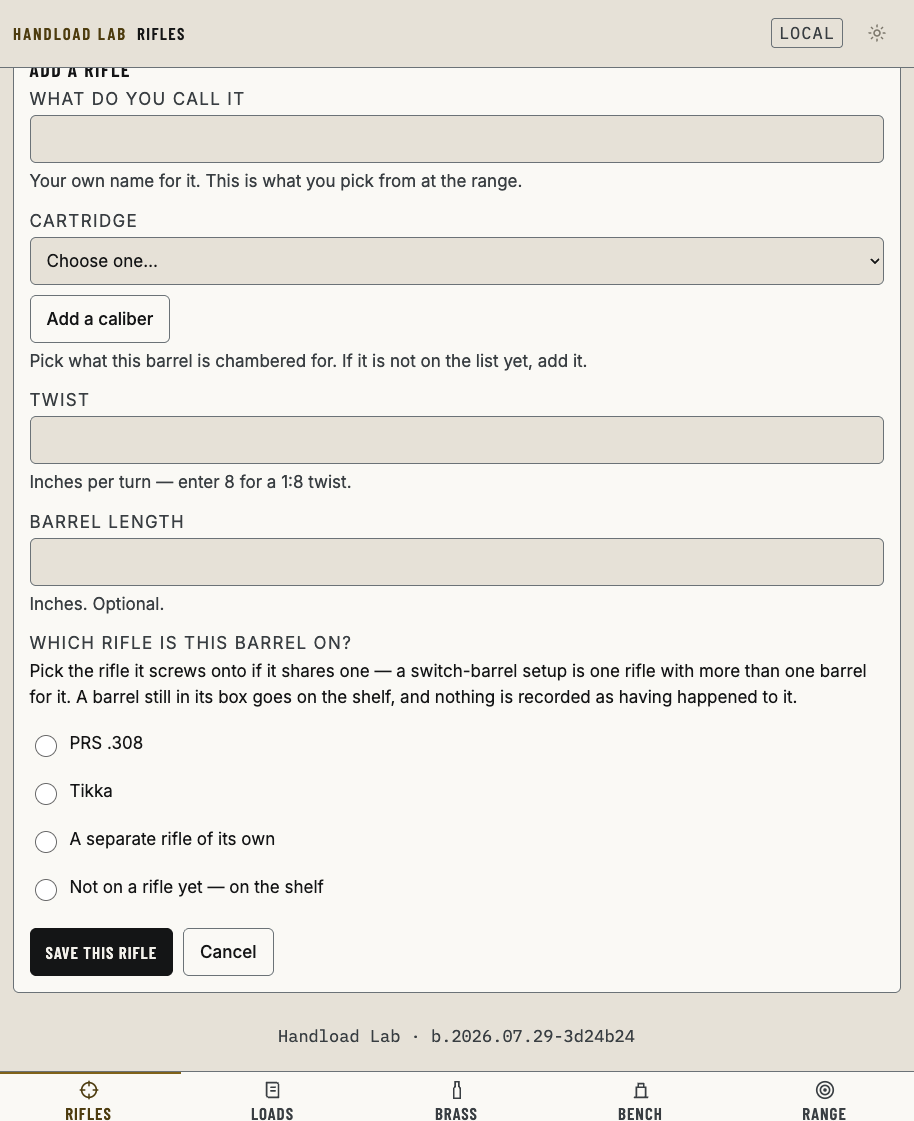
I have just built an app with Claude code to help me It So far is set to do the following Its almost complete for my purpose but will add other Gear, calibers ect… once Its worked through here is an overview: forgive the bad format of the cut and paste
HANDLOAD LAB
A guided load-development system for precision rifle
What it is
Handload Lab is a working ledger for developing precision rifle ammunition. It carries a shooter from an empty bench through a documented, repeatable load workup and ends with a defensible answer to a single question: which charge weight and seating depth does this rifle actually shoot best, and what is the evidence?
It is deliberately not a load-data database, and it is not a ballistics solver. Those products exist and are good at what they do. This one occupies the gap between them — the part of the process where a shooter is standing at a press with a published data table in one hand, a set of components on the bench, and no structured way to plan the test, execute it safely, or interpret the numbers that come back from the range.
It runs entirely in a web browser, which means it works on a laptop at the bench and on a phone at the firing line without installing anything. There is no server, no account, and no operating cost.
The governing principle
The application never generates a powder charge weight. Not from a model, not from interpolation, not from memory of a published table. Charge data exists inside the system for exactly one reason: a human read it off a named publisher’s data for that exact combination of bullet, powder, primer, and case, typed it in, recorded where it came from, and checked a box confirming they did so.
This is not a disclaimer. It is the architecture. A load record cannot be saved without a source. A charge ladder is generated strictly between the published starting charge and the published maximum, and there is no override — no advanced mode, no expert setting, no way to ask for one step higher. A user who enters a starting point below the published start has it corrected upward automatically, with the correction shown to them.
The reasoning is straightforward. In most software, a wrong number produces a wrong answer. In this domain, a wrong number produces a destroyed rifle and an injured shooter. Where that is true, the correct design is not to cite a source for a generated value — it is to refuse to generate the value at all.
Everything else the application computes is geometry, arithmetic, and statistics: bullet stability from twist rate, standard deviation from a velocity string, group size converted to angular units. None of those touch chamber pressure, and all of them are safe to calculate.
How it is used
The application is organized as five stations, and they are meant to be walked in order. The order is the method.
1 · Establish the rifle
Work begins with the rifle’s physical facts — cartridge, barrel length, twist rate — and a notes field for the chamber measurements a shooter takes once and refers to constantly: the fired-case shoulder datum, the freebore, the magazine’s maximum length.
Alongside the profile sits a stability calculator. Enter a candidate bullet’s weight and physical length and it returns the gyroscopic stability factor for that bullet in that barrel, with a plain verdict attached: stabilized with good margin, borderline, marginal, or will not stabilize. This answers the first question in any project, and it answers it before money is spent. A 1:8 twist 6.5 Creedmoor will stabilize nearly anything in its class; a 1:10 twist .308 has real limits with long heavy bullets, and it is far cheaper to learn that here than after a box of bullets arrives.
2 · Record the published data
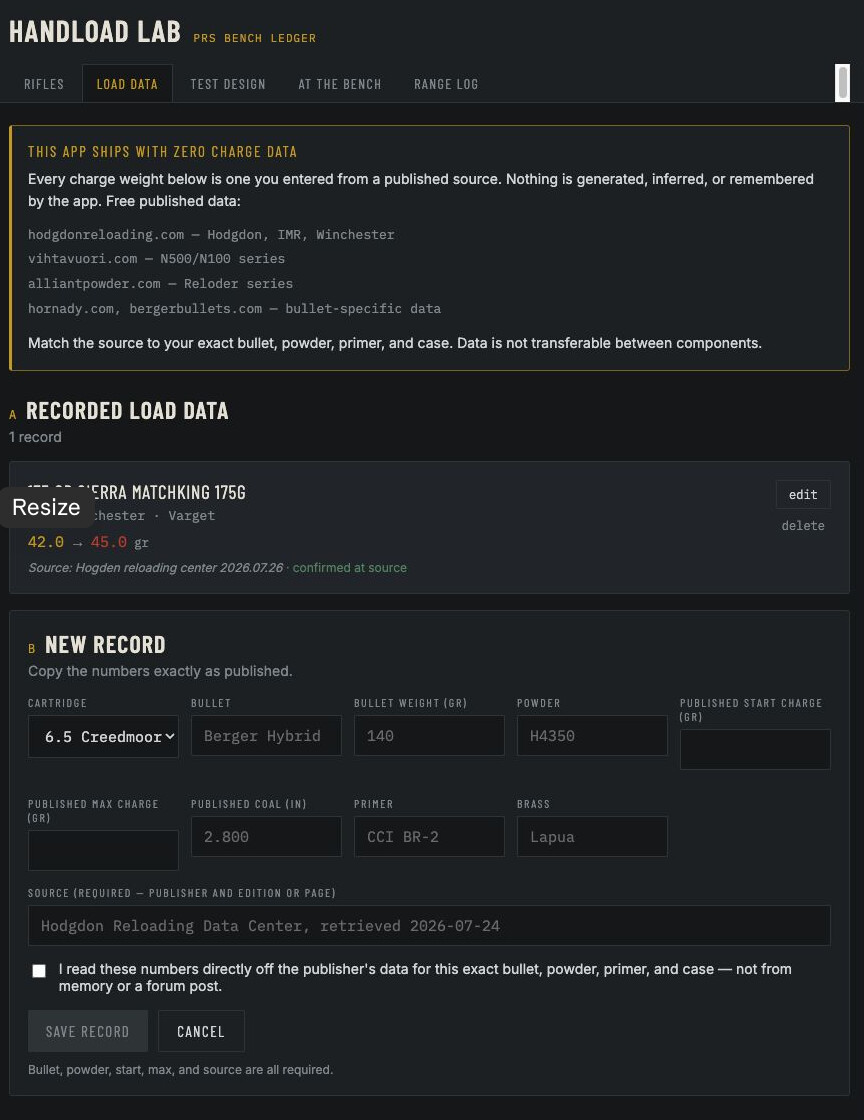
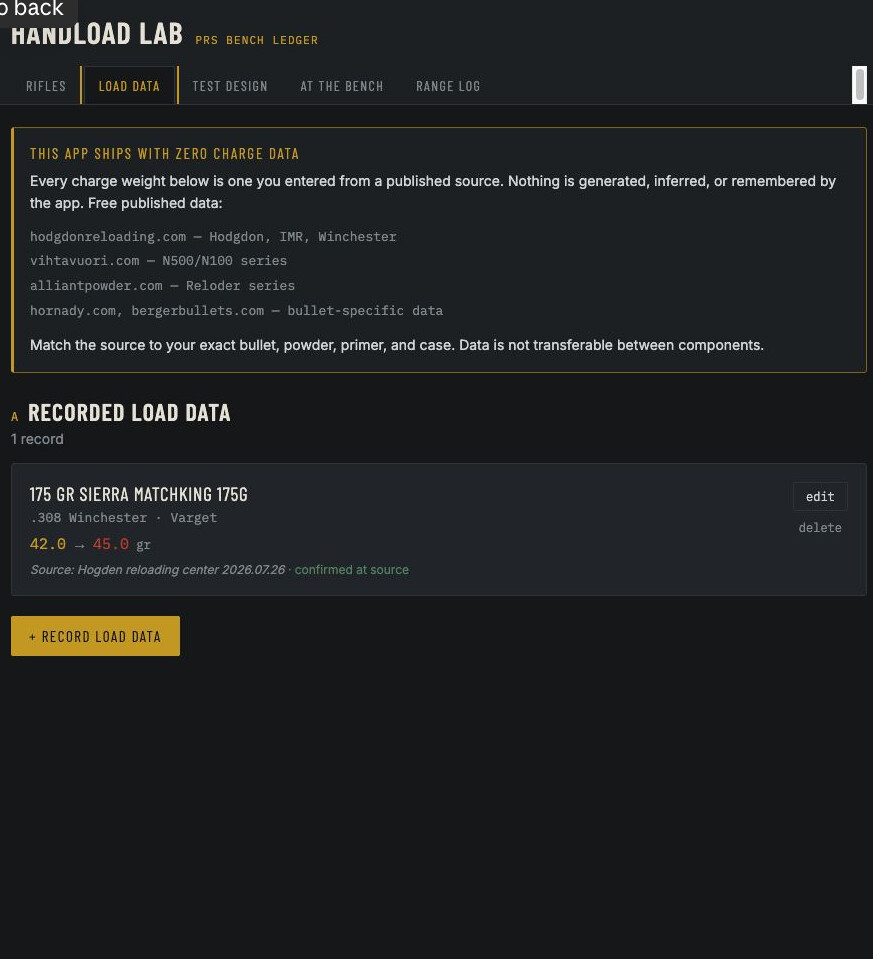
This is where charge data enters the system, and the only place it can. The station opens by stating plainly that the application ships with zero charge data, and points the user to the free published sources — the Hodgdon Reloading Data Center, Vihtavuori, Alliant, and the bullet manufacturers’ own tables.
Each record captures the bullet, its weight, the powder, the published starting charge, the published maximum, the published cartridge length, the primer, the brass, and — required, not optional — the source: publisher, edition, page or retrieval date. A confirmation checkbox asks the user to affirm that they read the numbers directly off the publisher’s data for that exact component set, rather than from memory or a forum post. Records that have not been confirmed are marked as such wherever they appear.
The record will not save if the maximum is not greater than the start. That single check catches the most common transcription error in the hobby: reading across two adjacent rows of a data table.
3 · Design the test
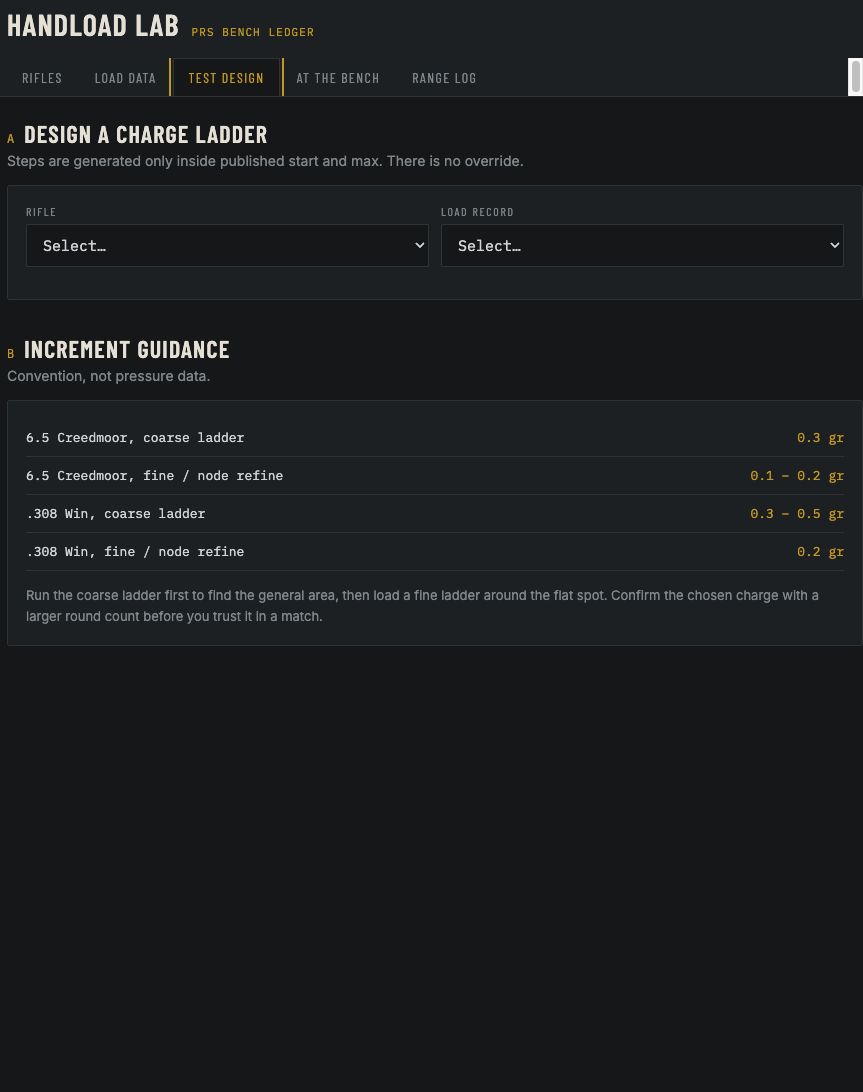
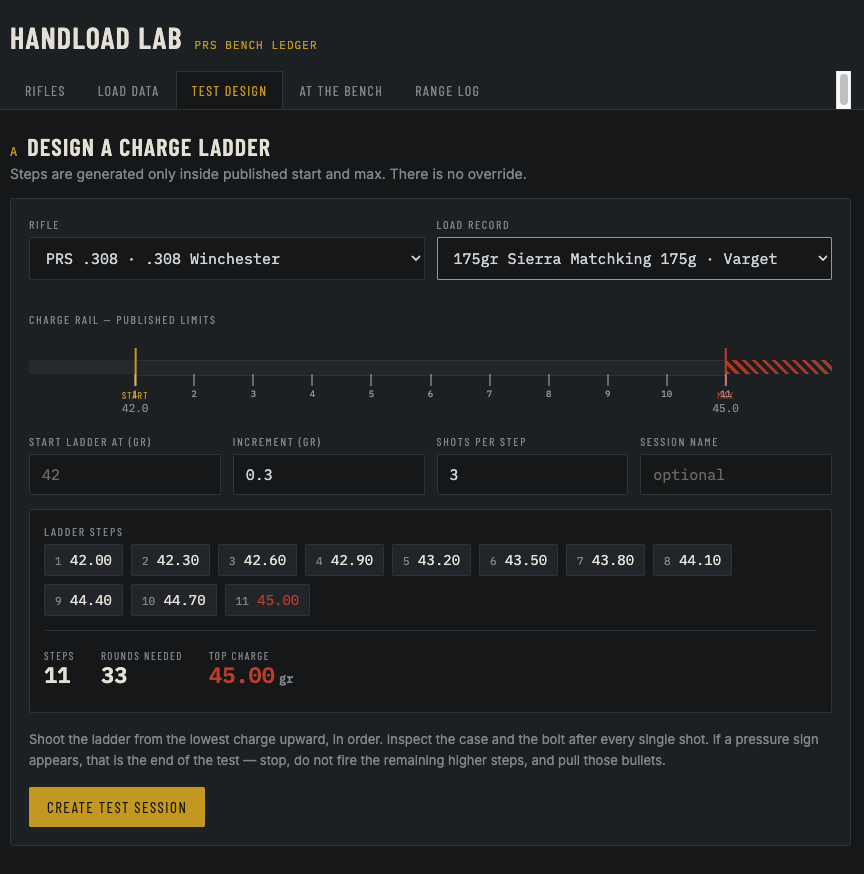
A charge ladder is a structured test that fires progressively heavier charges to find where a rifle shoots well. Designing one here means selecting a rifle and one of the recorded load records — the list filters itself to records matching the rifle’s cartridge — and choosing an increment and a shot count per step.
The centerpiece is a scale rendered like a micrometer. The published starting charge and the published maximum are drawn as hard stops. The region beyond maximum is hatched in red, and the application will not generate a step into it. The planned steps appear as numbered ticks along the working band, and the readout gives the step count, the total number of rounds to load, and the top charge of the test.
The station also carries increment conventions by cartridge — coarse spacing to find the general region, finer spacing to refine around a promising result — explicitly labeled as convention rather than pressure data, alongside the discipline of confirming a chosen load at a larger round count before trusting it in competition.
Creating the test writes a session with a row waiting for every charge step, and hands the user to the range log.
4 · Load the ammunition
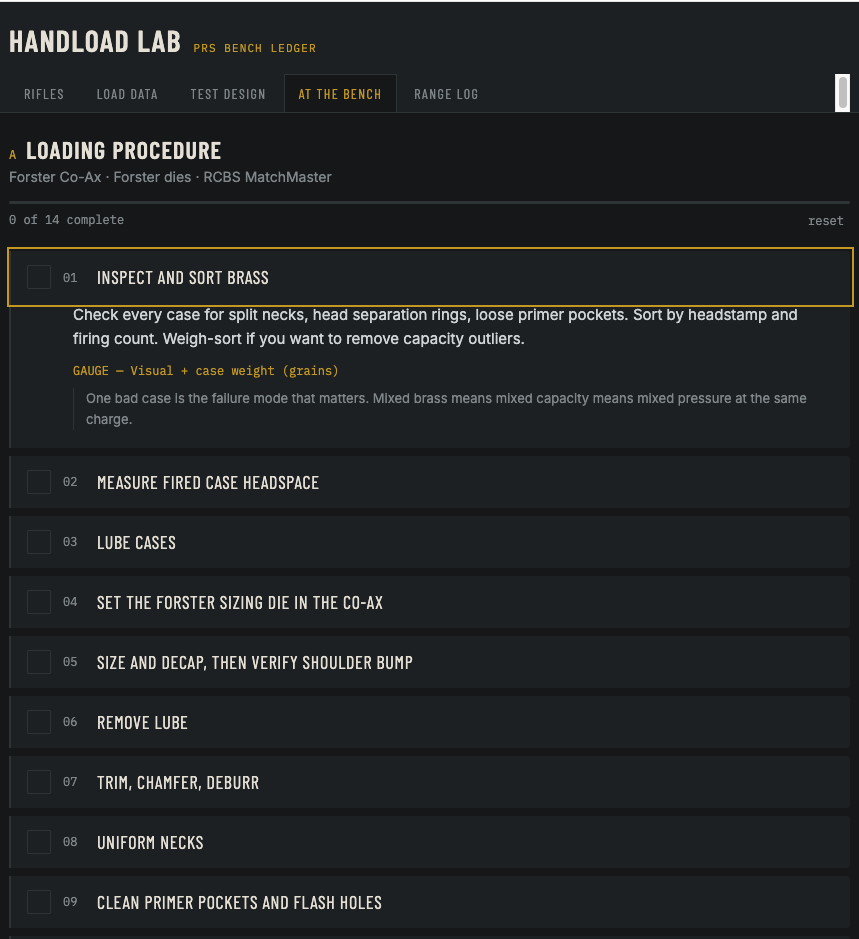
The bench station is a fourteen-step loading procedure written for a specific press and dispenser rather than in the abstract. Each step expands into three things: the action to perform, the instrument that verifies it, and the failure mode it exists to prevent. Steps are checked off against a progress indicator, so an interrupted session can be resumed without guessing where it stopped.
The sequence runs from inspecting and sorting brass, through measuring fired-case headspace, sizing and verifying shoulder bump, trimming, uniforming necks and primer pockets, seating primers, dispensing the charge, seating the bullet to a measured base-to-ogive dimension, and finally verifying and labeling the finished rounds.
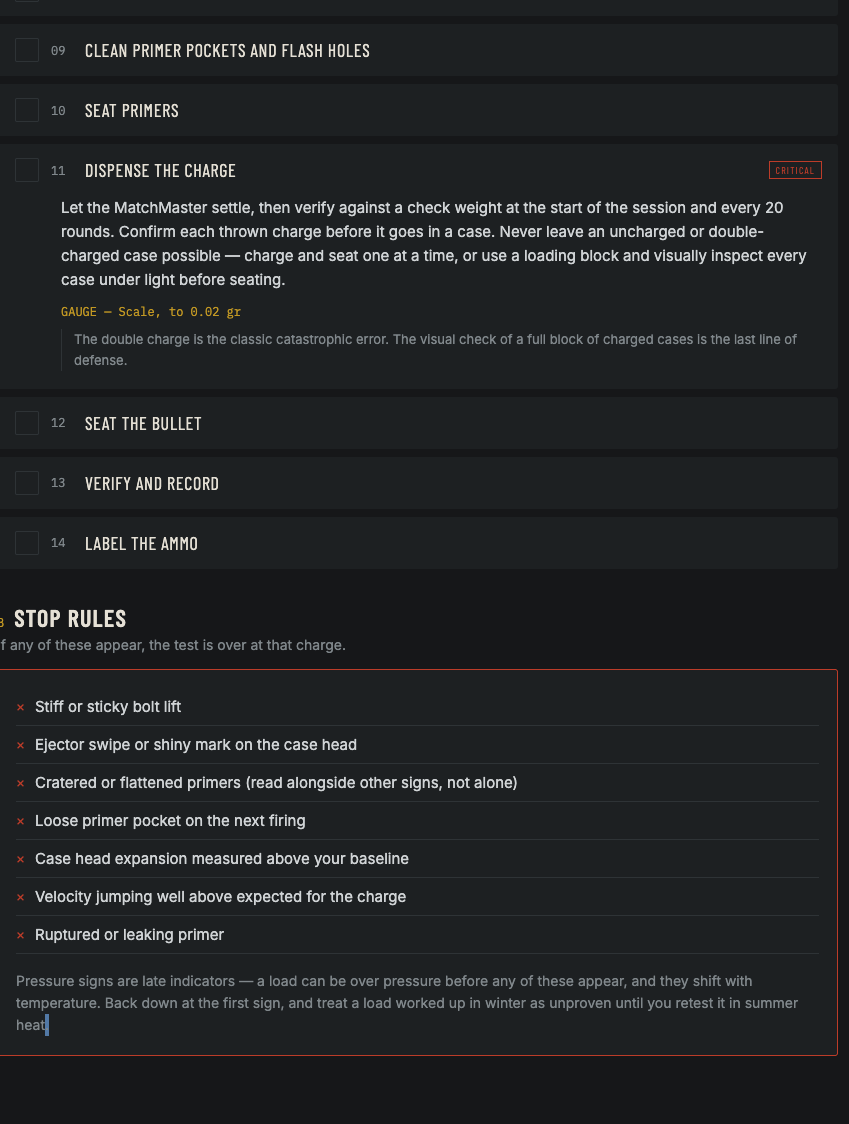
One step is marked critical and rendered in red: dispensing the charge. It carries the scale-verification interval, the one-at-a-time discipline, and the visual inspection of a charged loading block under light. The double charge is the classic catastrophic error in handloading, and the visual check is the last defense against it.
The station closes with the pressure signs a shooter must watch for — stiff bolt lift, ejector marks, flattened primers, loose primer pockets, unexpected velocity — followed by the honest caveat that these are late indicators. A load can be over pressure before any of them appear, and they move with temperature. A load developed in winter is unproven until it is retested in summer heat.
5 · Shoot it and read the result
At the range, each charge step gets a row. The shooter enters the velocities from the chronograph, the group size, the distance it was shot at, and the seating depth that was actually loaded. Everything else is computed as the numbers go in.
Average velocity, standard deviation, and extreme spread appear per step. Group size converts to both minutes of angle and milliradians, so it can be read in whichever unit the shooter’s scope speaks. The step with the lowest velocity deviation and the step with the smallest group are flagged automatically — they are frequently not the same step, and noticing that is the beginning of a real decision.
Across the whole ladder, average velocity is plotted against charge weight. This is the chart the entire exercise exists to produce: the flat spot, the region where adding powder stops producing a proportional increase in velocity, is where a tolerant and repeatable load tends to live.
Every step also carries a pressure-sign checkbox. Checking it turns the row red and states the rule without negotiation: fire no higher step in this session, pull the bullets on the remaining rounds, salvage the powder and brass. A pressure sign ends a test. It does not get shot through.
What it calculates
All computation is geometry, arithmetic, or statistics. Nothing in this list infers or predicts chamber pressure.
Gyroscopic stability factor By Miller twist rule, velocity-corrected Will this barrel stabilize this bullet
Average velocity by Arithmetic mean of the shot string How fast is this charge
Standard deviation by Sample standard deviation (n−1) How consistent is the ignition
Extreme spread by Fastest shot minus slowest: What is the worst case in the string
Group size, angular by Converted to true MOA and to mils How does the group compare across distances
Ladder steps by Fixed increments, published start to published max What exactly do I load, and how many rounds
Flat-spot curve by Average velocity plotted against charge Where is the tolerant node
What it records
The value of the system compounds with use. A single session answers one question; a season of sessions becomes the rifle’s documented history — what was tried, what it produced, and what the source was for every number involved.
• Rifle profiles — cartridge, barrel, twist, and the chamber measurements that everything downstream depends on.
• Sourced load records — the published window for each component combination, with its publisher and confirmation state.
• Test sessions — every ladder designed, dated, tied to a specific rifle and a specific load record.
• Range results — velocities, group size and distance, seating depth, and pressure observations, per charge step.
• Derived performance — the statistics above, recomputed live, plus the best-performing step in each session by both consistency and group size.
• Bench progress — which loading steps are complete in the current session.
Data is held locally on the device. Nothing is transmitted anywhere.
Current scope
In scope today
Cartridges 6.5 Creedmoor and .308 Winchester
PLATFORM Written against a Forster Co-Ax press, Forster dies, and an RCBS MatchMaster dispenser
Platform Browser-based; laptop at the bench, phone at the range
Cost to operate None — runs client-side with no server and no external services
The cartridge list is a configuration choice rather than a structural limit; additional cartridges are a table entry, not a rewrite.
Where it is headed
The immediate development path extends the same principle — more structure around the human’s judgment, never a substitute for it.
• Multi-source validation. Published data for the same component set from two independent publishers, shown side by side, with disagreements flagged and the more conservative bounds governing. Candidate recipes gathered from anywhere else are quarantined and cannot generate a test until they are backed by a published source.
• Seating-depth testing. The second axis of load development: hold the charge constant and vary how far the bullet sits from the rifling. Charge ladders answer half the question.
• Bullet specifications. A small, source-tagged reference for the bullets actually in use — weight, measured length, and ballistic coefficients — feeding the stability calculator and providing clean figures to carry into a dedicated ballistics solver.
• Chronograph import. Read shot strings directly from the chronograph’s export file rather than transcribing them by hand at the firing line.
• Export and offline install. Range data out to a spreadsheet, and installation as an offline application for ranges with no signal.
• Retrieval over the user’s own library. Search across the load tables the user has transcribed — with an absolute rule that an inexact component match returns “no published data on file” rather than the nearest similar row. Substituting a near-match component is precisely how an overpressure event happens.
Handload Lab is a discipline made visible. It does not make the shooter’s decisions, and it will not supply the one number that matters most. It ensures that every number in the record came from somewhere real, that every test was designed inside safe limits, and that at the end of a season the shooter can say not just what their rifle likes, but exactly how they know.
 that the ball in the forster dies is good but if you are trying to get down consistently in the .25 - .5 range on the bench tighter spec mandrels are the way to go. My reading says PRS shooters use a mandrel . this year Its my desire to go and take lessons and learn the techniques to shoot PRS for fun and maybe at some point if I love It compete locally. I can when I’m in my self researched behavior achieve sub MOA on the bench at my local 200 yd range. I feel like my fliers or outside the circle shots are due mostly and I say mostly to factory ammo. not immune to a hiccup here or there. for the factory ammo, when I put It on the chronograph there can be some bigger swings here or there. Mostly i get tight ranges for the ammo and I’m sure seating specs vary too. so the few that stray are a factor of that.

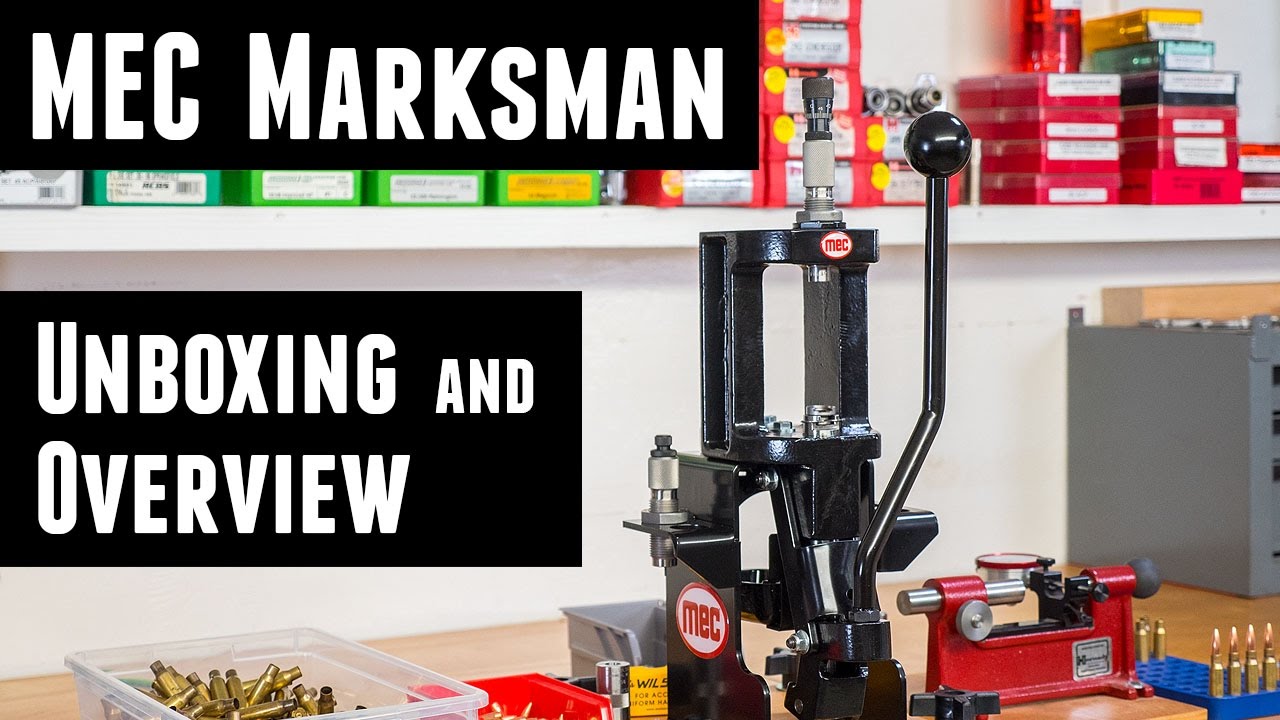

 pretty consumed